Sql-Server

SQL: Why is SQL Server Configuration Manager missing?

SQL: Why is SQL Server Configuration Manager missing?

Ever since it appeared back in earlier versions of SQL Server, I’ve normally launched SQL Server Configuration Manager from the Start menu in Windows. But every now and then, with some versions, it seemed to disappear. Now with the latest version of SQL Server installed on the latest version of Windows, it’s not there at all.

While it is possible to put it back in the menu, I think it’s time for us to get used to starting it in a different way.

2019-03-21

SDU Tools: Finding out how large SQL Server tables are with ListUserTableSizes

SDU Tools: Finding out how large SQL Server tables are with ListUserTableSizes

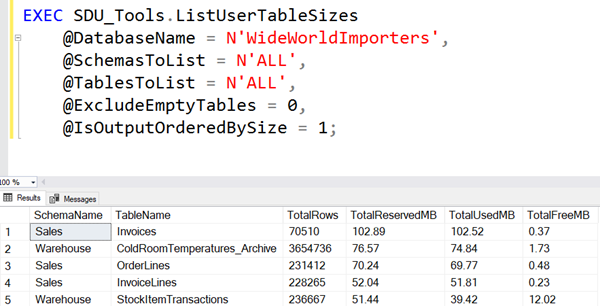
In our free SDU Tools for developers and DBAs, we have a number of functions and procedures that help you work with tables and indexes. One question that often arises is about how big tables are. Our tool ListUserTableSizes helps with that.

SQL Server Management Studio (SSMS) has a report that shows you user table sizes, but people often want a list of sizes that they can get programmatically, perhaps for a monitoring tool, or some sort of automation.

2019-03-20

T-SQL 101: 9 Finding out what's in a SQL Server table

T-SQL 101: 9 Finding out what's in a SQL Server table

In the last post, I described what tables were, and then showed how to view their contents using an option in Object Explorer in SQL Server Management Studio (SSMS).

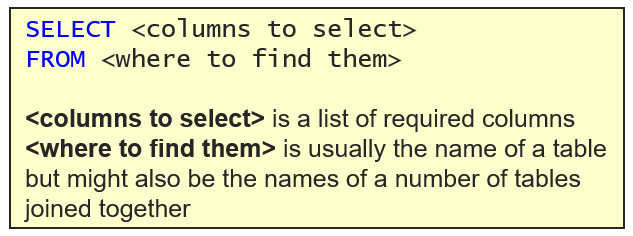
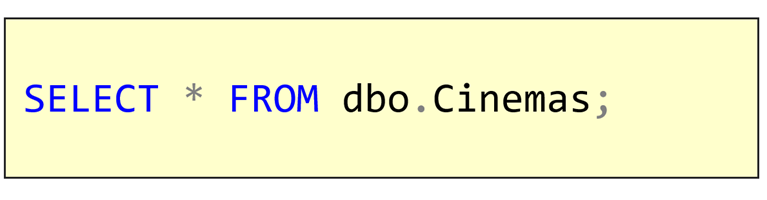
If you’ve ever seen a SQL query of any type, you will have seen one like this:

It says to return all columns from the table, and to return all rows.

Fair enough.

But there are a few things to understand about this simple statement:

2019-03-19

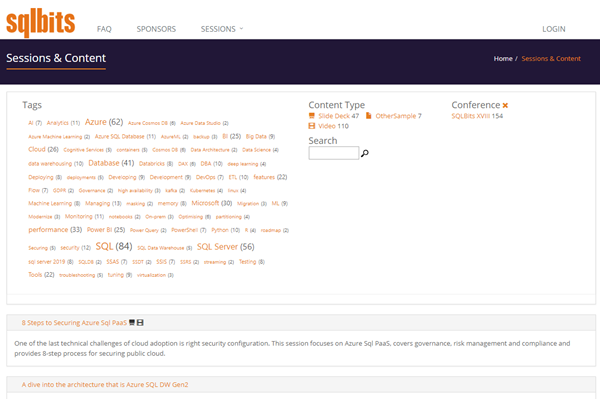
SQLBits - A World of Free SQL Server and Data Information Online

SQLBits - A World of Free SQL Server and Data Information Online

There are many SQL Server events around the world each year, and many are just awesome events. One that has grown non-stop and is currently my pick of these events is SQLBits.

Our UK buddies behind this (currently Simon Sabin, Darren Green, Annette Allen, Jonathan Allen, and Alex Whittles) have created an event that all others should be looking to.

I love the way they combine technical content with fun.

2019-03-18

Our new online on-demand SQL Server Reporting Services class is now live!

Our new online on-demand SQL Server Reporting Services class is now live!

Need to learn SQL Server Reporting Services or know someone else that needs to?

We’ve been working hard to move all our popular in-person training courses online and on-demand, so anyone in the world can take them.

Our SQL Server Reporting Services for Developers and DBAs course is now out the door.

This is the same course that we run as the first day of our 5 day BI Core Skills course. And it’s not just videos, there are:

2019-03-16

SQL: What's negative rounding in SQL Server T-SQL?

SQL: What's negative rounding in SQL Server T-SQL?

I remember being pleased some years back when I finished reading all of SQL Server’s Books Online (now just the documentation pages for T-SQL and SQL Server). The more of those pages I read, the more I was fascinated by small things that I hadn’t noticed even though I’d used the product for a long time. There’s so much to SQL Server and even just to T-SQL, that I still find unexpected things all the time.

2019-03-14

SDU Tools: TrainCase and KebabCase in T-SQL

SDU Tools: TrainCase and KebabCase in T-SQL

In our free SDU Tools for developers and DBAs, a number of the string formatting functions have been quite popular, and we keep getting requests for even more.

Today’s post highlights another two of these. TrainCase is words with the first letters capitalized, then separated by underscores. KebabCase has dashes as separators. It’s named because it looks like a kebab.

You can see them (and some others) in action in the main image above, and in this video:

2019-03-13

T-SQL 101: 8 What are tables in SQL Server?

T-SQL 101: 8 What are tables in SQL Server?

I mentioned previously that databases hold collections of information about related things. But what are these “things”? Well, that’s what the tables are.

Tables are the most basic objects that live in a database. They hold information about one type of thing. You might call the things “entities” but it’s not 100% accurate. It’s the same problem if you call them “objects”. They aren’t really objects. They basically are just “things” that we’re storing information about, like employees, books, cinemas, products, and more. ANSI SQL called them “relations”.

2019-03-11

SSMS: Accessing script files and folders in SQL Server Management Studio

SSMS: Accessing script files and folders in SQL Server Management Studio

This one is a very simple and quick tip.

When working in SQL Server Management Studio (SSMS), I often need to open File Explorer in the folder where the script file is stored. Turns out there is an easy way to do that.

There are two interesting options when you right-click the tab at the top of a query window:

Note that you can open the containing folder for the script. You can also copy the path to the script into the clipboard.

2019-03-07

SDU Tools: Screaming Snake Case and Sponge Bob Snake Case in T-SQL

SDU Tools: Screaming Snake Case and Sponge Bob Snake Case in T-SQL

In our free SDU Tools for developers and DBAs, a number of the string formatting functions have been quite popular, and we keep getting requests for even more.

Today’s post highlights two of these. Screaming Snake Case is words in capitals separated by underscores. Sponge Bob Snake Case has underscore separated words (hence the “snake case” part) with alternating capitals. (It’s just for fun).

You can see them (and some others) in action in the main image above, and in this video:

2019-03-06