
Book Review: The Psychology of AI Adoption at Work
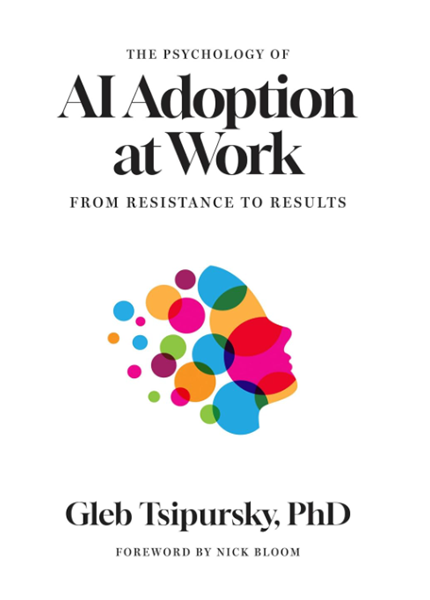
I’ve spent a lot of time lately considering the ethics surrounding AI usage in the workplace, but the title of a new book had me intrigued. I was sent a review copy of The Psychology of AI Adoption at Work: From Resistance to Results by the author.
Author
Dr. Gleb Tsipursky is a behavioural scientist, author and consultant who specialises in workplace change, decision-making and the future of work. He is the CEO of Disaster Avoidance Experts, a consultancy that helps organisations adopt new technologies and improve business performance. He previously spent more than 15 years in academia, including seven years as a professor at Ohio State University. He has written eight books and has been featured in publications including Harvard Business Review, Forbes and The New York Times, which described him as an office whisperer.
The Psychology of AI Adoption at Work
The biggest mistake organisations make with AI might be assuming that buying the technology is the same as getting people to use it. That’s the central argument in the book and I’m sure that Gleb is correct about that. Organizations can spend a fortune on AI tools and still achieve very little if employees don’t trust them, managers don’t support them, or nobody can explain what problem they are meant to solve.
What I like most about this book is that it treats AI adoption as a people problem, not simply a technology project. Gleb takes employee fears seriously, including concerns about job security, unreliable results and loss of control over work. He also makes an important point about middle managers. Senior executives can announce an AI strategy, but managers have to make it work while dealing with real workloads, worried employees and the consequences when something goes wrong. Too many technology rollouts underestimate that pressure.
One of the book’s more interesting ideas is to group managers and employees according to their attitudes towards AI. Employees range from alarmists and pragmatic resisters to cautious optimists and enthusiastic evangelists. I’m not sure that people really fit perfectly into those boxes, but the underlying point is useful. Someone worried about losing their job needs a different conversation from someone who wants permission to experiment. Sending everyone the same upbeat email about AI’s wonderful future is unlikely to win either of them over.
I particularly liked the emphasis on letting employees help create their own AI solutions, often using low-code or no-code tools. People are more likely to trust something they have helped build and understand. That’s a much better approach than having management select a product, provide a brief demonstration and then demand that everyone use it. The advice to start with small, useful projects, share results and build on success also makes good sense. If a tool removes an irritating task from someone’s working day, that will do more to encourage adoption than another executive presentation.
It was great to see the book’s foundations. It isn’t just opinion and is backed by research, interviews with business leaders and examples from organisations including Mayo Clinic, Mastercard and smaller businesses that the author has advised. It also covers training, communication, security, governance and measuring whether an AI project delivers worthwhile results. I was pleased to see the discussion move beyond counting licences and logins. Time saved matters, but so do accuracy, customer satisfaction and what people actually do with the time they gain. Using AI more often is not, by itself, proof of success.
Limitations?
Where I disagree a bit with Gleb is in the book’s underlying optimism about overcoming resistance. At times, it feels as though almost every objection is a psychological barrier that better communication and training can resolve. But sometimes the sceptics are right. An AI system really might be too inaccurate, too expensive, or too risky for a particular job. And concerns about employment aren’t imaginary. One of the author’s own law-firm examples includes a reduction in some staff roles after AI adoption. Employees are entitled to notice the gap between reassuring messages and what actually happens.
I’m also less convinced by the enthusiasm for employees building their own AI tools. That can be a great way to encourage ownership, but creating a useful prototype and maintaining a safe, reliable business system are two entirely different things. The book does discuss governance, yet I think it sometimes makes the path from enthusiastic experimentation to lasting business value sound smoother than it will be in practice.
My only other criticism is that the book could be tighter. Some messages like communicate openly, provide training, encourage champions, measure results are repeated enough that the later chapters occasionally feel like another version of the earlier ones. The frameworks and end-of-chapter questions will be useful to someone leading an organisation-wide rollout, but readers looking for a sharper, shorter argument may find it more detailed than necessary.
Summary
Even with those reservations, I think this is a worthwhile book, especially for business leaders and managers who are focused on choosing AI products but haven’t thought enough about the people expected to use them. Its strongest message is also its simplest. Successful AI adoption is not something you do to employees. It is something you have to work through with them. I would just add one condition that genuinely listening to employees must include accepting that, sometimes, their answer should be no.
7.5 out of 10
2026-11-06