
Book Review: Data Quality Management with AI
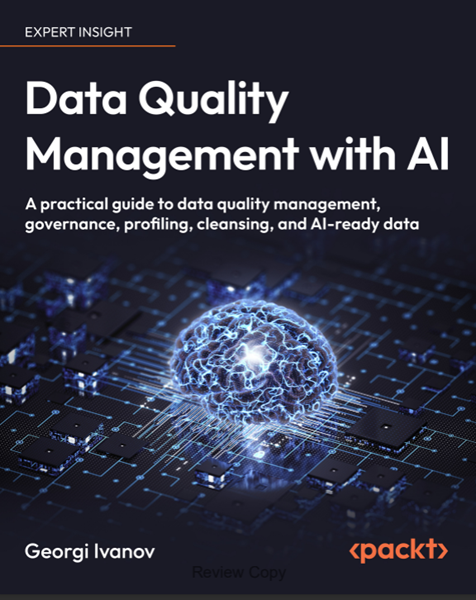
Data quality is a serious interest for me, and I’ve been disappointing how little progress the industry has really made on this in recent years. Even SQL Server that I work with, introduced Data Quality Services back in SQL Server 2012 and later removed it. I think that was a pity. What’s interesting though, is that AI is likely to breathe new life into this work, so I was pleased to recently receive an early review copy of Data Quality Management with AI from my friends at PacktT.
Author
According to the book, Georgi Ivanov is a tech educator and data product leader with more than 15 years in the technology industry. It says he held senior roles at Hewlett Packard Enterprise and VMware, where, as Senior Data Product Owner, he worked at the intersection of data governance, data quality, and product strategy.
He seems well position to write on this topic.
Data Quality Management with AI
Data quality is one of those subjects that almost everyone agrees is important, but surprisingly few organizations seem to manage well. I’ve seen plenty of situations where considerable effort goes into building data warehouses, reports, and analytics solutions, only for the results to be questioned because nobody trusts the underlying data. Georgi tackles this problem from a practical perspective, while also exploring how artificial intelligence can help. I think it’s a useful introduction to an important subject, although I have some reservations about the depth of the material.
One thing I like about this book is that it doesn’t immediately jump into AI. Instead, Georgi starts with the fundamentals of data quality and why organizations need to take it seriously. He uses the NASA Mars Climate Orbiter failure as an example of how seemingly small data problems can have enormous consequences. It’s a familiar story, but an effective reminder that data quality isn’t simply about making reports look better.
The early chapters cover the six main dimensions of data quality: accuracy, validity, timeliness, completeness, uniqueness, and consistency. These are explained using simple examples, often involving employee information. I particularly liked the distinction between accuracy and validity. A value can be perfectly valid according to its format and still be completely wrong. That’s an important concept that is often overlooked when organizations rely too heavily on automated validation rules.
The chapters on defining data quality rules, profiling data, and cleansing are also useful. Georgi shows how business requirements can be turned into checks that can be implemented in spreadsheets or SQL. I appreciated the emphasis on making rules measurable and documenting them properly. Data quality rules shouldn’t just exist in someone’s head or be buried in application code where nobody can find them.
The discussion of matching, linking, and deduplicating records is another worthwhile inclusion. Anyone who has worked with customer information knows how difficult it can be to determine whether two slightly different records represent the same person or organization. When I’m teaching classes, I often use how to identify a person as an example of how difficult this all can be. These problems become particularly challenging when information comes from multiple systems. The book introduces the concepts clearly, although I would have liked more depth on techniques for handling uncertain matches.
For me, one of the strongest messages comes from the chapters on monitoring and governance. Fixing bad data once is relatively easy compared with preventing the same problems from returning. Georgi describes a five-step improvement process and introduces root cause analysis using the Five Whys technique. I hadn’t seen this spelled out this way before but I like this approach. If you repeatedly clean the same data without fixing the process that creates the errors, you’re really just hiding the problem. But you can’t always fix the source. I wish you could.
The AI material is interesting, particularly the examples using Microsoft Copilot and ChatGPT to identify missing values, detect duplicates, standardize information, and generate SQL validation scripts. These are sensible applications of AI, and I can see them saving considerable time, especially during initial data exploration. The book also correctly emphasizes the importance of checking AI-generated results rather than simply accepting them.
The later chapters cover data quality tools, organizational responsibilities, and career development. I found the discussion of roles such as data owners and data stewards quite solid. The career advice, including certifications, resumes, and interview preparation, will be helpful to newcomers, although it takes up space that more experienced readers might have preferred to see devoted to technical implementation.
Limitations??
I think the title creates expectations that the book doesn’t entirely meet. Much of the content is traditional data quality management, with AI added to selected activities. There’s nothing wrong with that, and the fundamentals are arguably more important than the AI features. But readers expecting a detailed treatment of AI-driven data quality systems, automated monitoring, or sophisticated anomaly detection might be left wanting for more.
I also think the examples are generally quite basic. The practical project uses a customer dataset of 1,000 records, and the book includes useful scenarios involving insurance, logistics, banking, finance, and healthcare. These help explain the concepts, but they’re a long way from managing data quality across millions of records and complex production pipelines. I would have liked more discussion of building repeatable automated checks, managing exceptions, and measuring improvements over time in large systems.
Another concern is that AI-generated corrections can introduce new problems. Identifying a suspicious value is one thing; deciding what the correct value should be is quite another. This is particularly important when matching customer records or filling in missing information. I would have liked stronger guidance on when automated changes are appropriate and when human approval should be required.
Summary
Data Quality Management with AI is a good introductory book for analysts, data stewards, and people moving into data quality roles. It’s approachable, practical, and reinforces the importance of treating data quality as an ongoing business responsibility rather than a one-off technical exercise. Its main weakness is that it doesn’t go deeply enough into either enterprise-scale data quality engineering or advanced AI techniques. I would recommend it as a foundation, but experienced data engineers will probably want something more substantial. The most valuable lesson is also the simplest: AI can help improve data quality, but it doesn’t remove the need to understand your data, define sensible rules, and fix problems at their source.
7 out of 10
2026-11-25