
Book Review: Fair Game
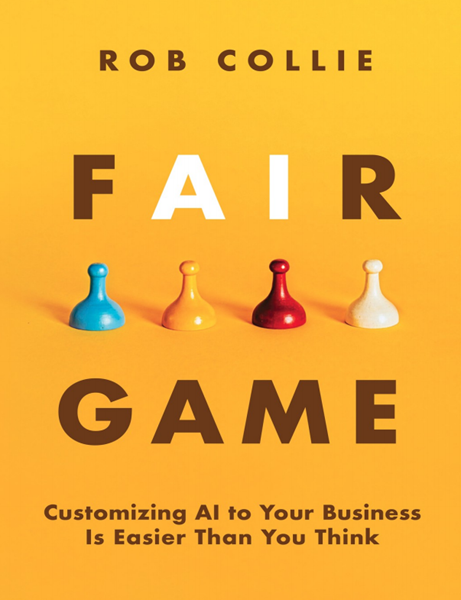
This book appeared as a direct advertisement in my Facebook feed. Generally, I wouldn’t buy books that way as they’re often shallow and uninspiring. But I decided to try it, and it was surprisingly low-cost. I was predisposed to not like it, particularly when I had some challenges in purchasing it (which Rob’s team sorted out well), but I ended up really enjoying reading it.
The book was Fair Game by Rob Collie.
Author
Rob Collie is CEO of P3 Adaptive, a consulting firm that builds custom AI and data solutions for mid-market and Fortune 1000 companies. He worked as an engineer at Microsoft for 13 years, predominantly in and around Power BI. It’s not surprising then, that I know many of the people that he mentioned in the book.
Fair Game
There is certainly no shortage of books about artificial intelligence at the moment. Some promise that AI will change absolutely everything, while others spend hundreds of pages explaining technology that most business people will never need to understand. Rob’s book takes a different approach. Its central argument is that using AI successfully in business is less about understanding the technology and more about understanding your business. I think that’s an important message, and one that often gets lost in the current excitement around AI.
Rob comes to this subject with an interesting background. He was heavily involved in the early development of Power Pivot and Power BI at Microsoft, before building a successful consulting business. That experience shapes much of his thinking. He has seen what happens when powerful technology becomes accessible to people who previously depended on specialist developers. He believes AI is creating a similar opportunity, but on a much larger scale.
One of the things I particularly like about this book is its focus on custom AI. Rob argues that tools such as ChatGPT and Claude are impressive, but that real business value comes from connecting AI to the specific information, processes, and requirements of an organization. His description of an LLM as having a PhD in everything except your business is a useful way of explaining the problem. The intelligence is already available. What’s missing is the business context.
The early chapters explain how large language models work and how they differ from traditional software. Rob deliberately avoids getting buried in technical detail, concentrating instead on the concepts that business leaders need to understand. I particularly liked his explanation of how conventional software and AI can work together. Traditional software provides predictable operations, while AI can interpret requests and make decisions that would be difficult to express as fixed rules. Combining the two is far more useful than expecting AI to do everything.
The book also introduces the idea of giving AI agents instructions, background information, and access to tools rather than trying to modify the underlying model. This is a practical distinction. Too many conversations about custom AI immediately jump to training or fine-tuning models, when much simpler approaches may achieve the desired result.
Rob’s own AI editor, Eddie, provides a particularly good example. Eddie helped review the manuscript, maintained awareness of the author’s writing style, and provided repeated feedback. It’s an effective demonstration of how an agent can become useful through carefully supplied context and instructions.
Another strong part of the book is the discussion of AI-assisted software development, which Rob calls Co-Building. He argues that AI makes it possible for people with deep business knowledge, but limited programming experience, to help create software that previously would have required specialist development teams. I agree with the general direction of this argument. The people who understand a business problem are often the people least able to build the software needed to solve it.
I also appreciated the emphasis on business leadership. Rob makes the point that AI projects should not simply be handed to IT departments with vague instructions to find opportunities. Business leaders need to identify worthwhile problems, provide direction, and remain involved. His distinction between Developers, Crafters, and Leaders is useful, even if the boundaries between those groups are not always as clear as he suggests.
The chapter on data is especially important, and clearly dear to my heart. Rob argues that organizations already have much of what they need to make AI valuable, but that their information must be made accessible and understandable. His discussion of structured data, semantic models, business definitions, and everyday organizational content is particularly relevant to anyone working with data platforms and business intelligence.
Limitations?
While I really enjoyed reading the book, I do have a few reservations. The printing quality was ok but not brilliant, and I wish the periodic breakout text sections weren’t in such a small font. That made it tougher going for tired eyes.
Rob is extremely optimistic about how much easier AI makes software development. Creating an initial application may now be remarkably quick, but making it secure, reliable, maintainable, and suitable for production remains challenging. He called out that people like me will surely raise those issues. I still think the book sometimes makes that gap appear smaller than it really is.
The conversational writing style is engaging and often entertaining, although some of the analogies and detours could have been shorter. The practical patterns in the final chapter and the two small development projects in the appendices help bring the ideas back to something readers can actually try.
Given Rob’s background, I wasn’t surprised by the amount of Power BI related content but some readers might find that a little odd. And having done a lot of exploring of Fabric IQ already, I’m not as convinced as Rob about how useful it is yet.
I know he was trying to avoid much technical detail, but there were areas that I thought were really too lightly treated. For example, the acronym MCP (Model Context Protocol) is only mentioned once on page 76.
Summary
Fair Game is a useful book, particularly for business leaders trying to move beyond experimenting with AI chat tools. I mentioned that I was predisposed to not like this book. But I really, really liked it. I don’t agree with every prediction or share quite the same level of optimism in the same areas, but I strongly agree with the need to bring business expertise into the centre of AI development. Rob makes a convincing case that organizations should stop asking what AI can do and start asking what they actually need it to do.
Great work Rob!
9 out of 10
2026-11-21