
Book Review: Flutter in Action
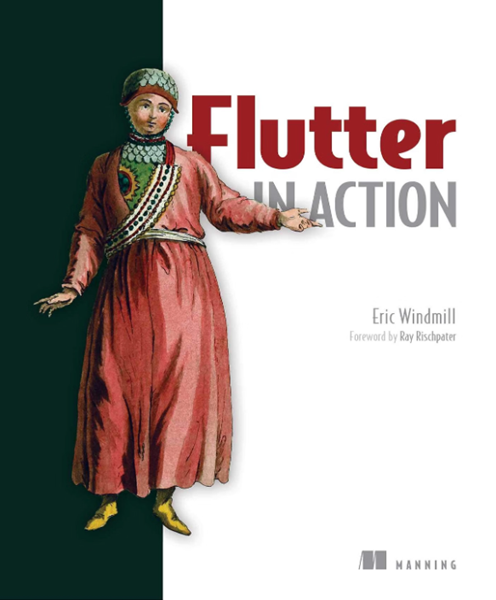
For today’s review, I decided to head more into Google territory. A while back, I purchased Flutter in Action . A number of my developer friends have been posting about Flutter for a while, and I’ve been meaning to check it out properly. Mostly, they’ve been developers who work on mobile applications.
Author
Eric Windmill is a software engineer, focused on client-side applications. He has worked with Flutter since it started and is the author of Flutter by Example .
Flutter in Action
Cross-platform application development has always sounded attractive. Write an application once, deploy it to multiple platforms, and avoid maintaining separate codebases. Of course, making that work well has often been harder than the marketing suggests. This book makes a strong case for Flutter as a solution to that problem. What I particularly like is that Eric doesn’t just explain how to build applications. He spends considerable time explaining how Flutter actually works, and I think that is where this book is at its best.
One thing that stands out immediately is his enthusiasm. Eric clearly enjoys working with Flutter, and that comes through in his writing. The style is conversational, sometimes humorous, and generally easy to follow. It feels more like having an experienced developer explain something to you than reading formal technical documentation. That makes a real difference when learning a new development framework.
The book starts by explaining why Flutter exists, how it compares with native mobile development and other cross-platform approaches, and why Google chose Dart as its programming language. I appreciated the discussion of Flutter’s rendering model and how it avoids some of the problems associated with JavaScript-based approaches. These are useful explanations because choosing a framework should involve understanding its architecture, not just looking at screenshots of attractive applications.
There’s a complete introduction to Dart, which I think is a sensible inclusion. Developers coming from JavaScript, C#, or Java will find much of it familiar, but Dart has its own way of doing things. The chapter covers the basics without becoming an entire programming language textbook. Experienced developers could probably skim it, but newcomers will appreciate having the information in one place.
For me, the strongest part of the book is the explanation of widgets and how Flutter builds its user interface. The idea that almost everything is a widget can seem strange initially, particularly if you’re used to separating markup from application code. Eric does a good job of explaining widget trees, stateless and stateful widgets, layout constraints, and the relationship between widgets and the underlying element tree. I particularly liked the discussion of why Flutter favours composition over inheritance. These are concepts that help developers understand the framework rather than simply copy examples.
The chapters on forms, gestures, styling, and animations are also useful. Flutter gives developers considerable control over how an application looks and behaves, and the book demonstrates that through practical examples. The animations chapter is especially interesting because it goes beyond using ready-made controls and explores custom painting and animation controllers.
State management is another area where I think the book does well. This is often one of the hardest parts of building larger applications, regardless of the framework. Eric explains the widget lifecycle, inherited widgets, and the BLoC pattern. He also covers asynchronous programming with futures and streams. These chapters require more concentration than the earlier material, but they are important. I would much rather see a book explain these concepts properly than hide them behind a library that makes everything appear easy.
I was also pleased to see chapters on working with HTTP, JSON, and Firebase, followed by testing. The testing coverage includes unit tests, widget tests, integration tests, and accessibility. These subjects are essential for building applications that people will actually use, rather than just demonstrations that look good on a developer’s machine.
Limitations?
My biggest concern with this book now is its age. It was published in 2020, and Flutter has changed substantially since then. The book uses Dart 2 and discusses APIs and approaches from Flutter’s early years. Some examples, including older button widgets and testing tools, reflect ideas from that time. Readers using a modern Flutter installation should expect to update code and find alternatives for some examples.
That matters more here than it would in a book about database fundamentals. Mobile development frameworks change so quickly, and beginners can become very frustrated when examples don’t compile. I found this book useful for core concepts, but at this point I would not recommend this book as someone’s only guide to learning Flutter today. It needs to be used alongside current documentation.
I also would have liked more discussion of the difficulties of maintaining larger applications and the trade-offs involved in choosing Flutter over native development. Eric acknowledges that Flutter isn’t always the right answer, but his enthusiasm sometimes makes the decision sound easier than it really is.
Summary
I enjoyed this book and think it explains Flutter’s original design exceptionally well. Eric mentioned in it that it was his first book. That’s always an achievement. Its greatest value is in teaching the principles behind widgets, rendering, state management, and asynchronous application development. Those ideas remain worth learning even when individual APIs change. I would recommend it to experienced developers who want to understand how Flutter works, but with a clear warning about its age. As a foundation for understanding Flutter, it’s very good. As a current, step-by-step development guide, it is showing its years.
I’d love to see him have a more up-to-date edition of it. Online though, there are many low-cost guides that have been published this year, so it’s hard to know if it’s worth the effort for him. But I do like his writing style.
6 out of 10
2026-11-20