
Book Review: Agentic Coding with Claude Code
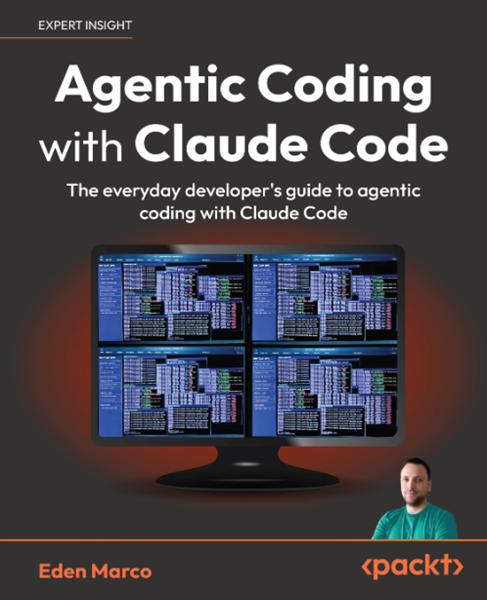
I recently received a review copy of Agentic Coding with Claude Code by Eden Marco from my friends at PackT.
Author
Eden Marco is an LLM specialist at Google Cloud and a LangChain Ambassador with years of experience in software engineering and cloud architecture. Over many years, he has created practical courses based on his real-world experience.
Content
This is a timely and practical guide for developers who are ready to move beyond casual AI-assisted coding and start treating coding agents as serious development tools. Eden’s main argument is that effective agentic coding is not just about writing better prompts. It is about engineering context: deciding what the agent should know, what it should ignore, what tools it should use, and how its work should be structured so that results are repeatable, controlled, and maintainable.
That focus on context engineering is the book’s strongest feature. So many developers begin with chat-style prompting and quickly discover its limitations once a project grows beyond small code snippets. Eden does a good job of explaining why long-running agent workflows need memory, tool access, planning, isolation, and feedback loops. The early chapters establish a useful mental model before moving into the practical mechanics of Claude Code, including project initialization, CLAUDE.md files, slash commands, hooks, and persistent memory.
I liked the way that the book doesn’t stop at how to use the tool. Instead, it explores the architectural ideas behind modern coding agents. The coverage of the Model Context Protocol is a good example. We’ve recently released a course that covers MCP in relation to SQL Server and there has been a high level of interest in this area. Rather than presenting MCP as a magic integration layer, Eden explains both its value and its trade-offs, including context pollution and efficiency concerns. That makes the book more useful than a simple product walkthrough.
I also liked the progression from individual workflows to larger patterns: GitHub automation, planning mode, multi-agent development, subagents, output styles, agent skills, Claude Code Desktop, and deep agents. That gives you a broad view of how agentic development can evolve from a developer productivity aid into a more structured engineering workflow. The recurring HookHub-style examples are useful and once again, it’s great to see a companion repository. That makes the book so much more practical.
The book is not aimed at beginners. Instead, readers are expected to be comfortable with Git, terminal-based development, Python or TypeScript, and basic GenAI concepts such as LLMs, RAG, and agents. That makes the pacing appropriate for working developers, but it would be an issue for someone still learning programming or AI fundamentals.
There are also a few natural limitations. Claude Code and its surrounding ecosystem are changing quickly, so some details about pricing, interfaces, available commands, or integrations may date faster than the underlying concepts. In general, as tempting as it is to include these things, I think they’re best omitted, as they will date the book quickly, and they’re really not needed. The book’s strongest long-term value isn’t about memorizing exact commands, but about understanding the patterns: context management, scoped tools, reusable workflows, agent isolation, and human oversight.
Summary
This is a strong, practical, and conceptually useful book for developers who want to use Claude Code seriously. It succeeds because it treats agentic coding as an engineering discipline rather than as some sort of prompting trick. For software engineers, AI engineers, and technically confident GenAI practitioners, it provides a helpful bridge between everyday AI pair programming and more deliberate, scalable agent-driven development.
Well done!
9 out of 10
2026-07-03