
Fabric RTI 101: Handling Retries

In any real-time system, we can’t assume that every event will be delivered successfully on the first attempt. Network interruptions, temporary service outages, or throttling limits can all cause event delivery failures.
That’s why retry logic is a fundamental part of reliable streaming architecture.
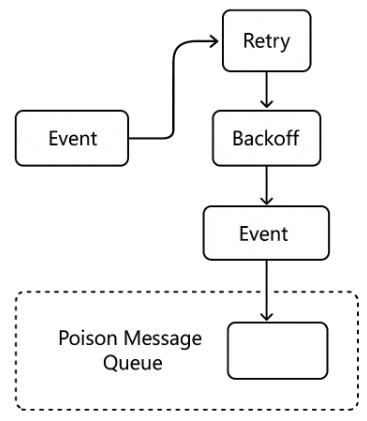
The most common approach is to use exponential backoff — meaning that the system waits progressively longer between retries. This avoids overwhelming the destination service during outages. For example, retries might occur after 1 second, then 2 seconds, then 4, and so on, up to a maximum delay.
However, retries can introduce another challenge: duplicate events. If a message is retried and the previous attempt eventually succeeds, both versions could be processed.
To handle this safely, design your system to be idempotent — in other words, processing the same event twice should produce the same outcome. This might involve checking event IDs, timestamps, or sequence numbers to ensure no duplication in the final results.
Another best practice is to implement poison message queues. These are special queues used to isolate problematic events that consistently fail processing. By diverting these messages away from the main pipeline, you prevent a few bad events from blocking or slowing down the entire stream.
Finally, make sure to log all retries — both successful and failed ones. This helps with monitoring, troubleshooting, and root cause analysis. If a service starts to show an increasing retry rate, it’s often an early sign of underlying performance or connectivity problems.
Handling retries effectively is about resilience and control. You accept that failures will happen, but you ensure that when they do, the system recovers gracefully, avoids duplication, and provides the observability you need to fix the issue quickly.
Learn more about Fabric RTI
If you really want to learn about RTI right now, we have an online on-demand course that you can enrol in, right now. You’ll find it at Mastering Microsoft Fabric Real-Time Intelligence
2026-08-11