
Book Review: Python for Algorithmic Trading Cookbook
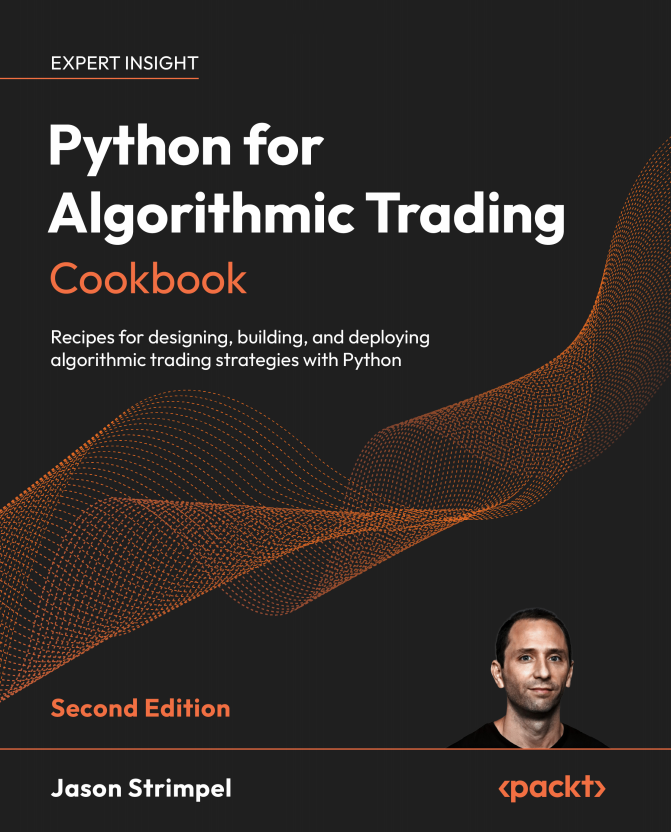
I recently received a review copy of Python for Algorithmic Trading Cookbook (2nd Edition): Recipes for designing, building, and deploying algorithmic trading strategies with Python by Jason Strimpel from my friends at PackT.
Author
Jason Strimpel is the founder of PyQuant News, co-founder of Quant Science, and Managing Director of Global AI and Advanced Analytics at a top-tier consulting firm.
Content
This book is an ambitious, highly practical guide to building the complete research-to-execution workflow for systematic trading. It treats algorithmic trading as an engineering discipline involving data acquisition, storage, analysis, backtesting, risk measurement, execution, and deployment. I was surprised by the breadth of modern tools that are discussed: 68 recipes, 51 Jupyter notebooks, 17 modular trading applications, and four GPU-focused scripts.
I like cookbook-style books. Often, I don’t want to learn every aspect of a concept, but just want to see examples of how to use it. The recipes in the book mostly begin with the required setup, move through implementation steps in order, explain how the code works, and then suggest extensions. This structure makes the book suitable both for sequential study and for later use as a reference.
Jason’s explanations are direct and based on real tasks rather than abstract demonstrations. For example, he doesn’t just teach basic DataFrame operations; instead, the examples use pandas, Polars, DuckDB, Parquet, and ArcticDB to process and manage substantial financial datasets. The ArcticDB material is especially valuable because it addresses reproducibility and look-ahead bias through versioned, point-in-time data.
I also like the way that the examples connect across chapters. Data prepared earlier is reused in later research, backtesting, and deployment exercises, so the book feels more coherent than a collection of unrelated snippets. It’s always hard to know whether to take this approach or not. It lets you build something more substantial, but can make it harder for someone who wants to just dive in later. It works best for someone reading the whole book. The used of procedural notebooks keeps the early material approachable, while the modular application built in later chapters introduces separation of clients, wrappers, contracts, orders, and utilities without becoming too architectural.
The best part of the book is its end-to-end scope. It progresses from sourcing equities, futures, options, and factor data through visualisation, alpha-factor construction, vectorised and event-driven backtesting, factor evaluation, portfolio analytics, and live brokerage integration. The backtesting chapters also go beyond reporting attractive returns. Walk-forward testing is used to investigate overfitting, while Zipline Reloaded examples incorporate commissions and slippage. Alphalens and Pyfolio recipes examine information coefficients, turnover, drawdowns, exposures, transaction costs, and trade-level performance. This emphasis on robustness distinguishes the book from many introductory trading texts. That’s amazing detail for this type of book.
The later chapters seem quite current. A substantial section explores AI-assisted research with LangChain, LlamaIndex, retrieval-augmented generation, and multi-agent workflows. Importantly, Jason presents these systems as tools for accelerating research rather than replacing human judgement. The chapters on Interactive Brokers build reusable application components for contracts, orders, streaming data, positions, portfolio profit and loss, and paper or live deployment. This gives readers a credible path beyond notebooks and into operational systems.
Are there any limitations? Sure. The breadth of topics means that several sophisticated ones receive recipe-sized treatments rather than deep theoretical development. This is not a university textbook on the topic. So readers seeking rigorous derivations of factor models, portfolio optimisation, market microstructure, or statistical testing will need additional reading material. I could also see some potential installation issues with the large technology stack that’s used, particularly because several libraries evolve quickly and some examples require API keys, premium data, an Interactive Brokers account, or specialised configuration. The final GPU chapter is impressive, but if you want to follow its largest examples, you’ll need appropriate NVIDIA hardware and considerable memory, although smaller datasets can be substituted.
This is clearly not an introductory-level first Python book. Readers should already understand basic syntax, pandas, NumPy, and common financial terminology. The real value in the book is in providing templates for disciplined experimentation.
Summary
I didn’t ever get to read the first edition of this book, but this second edition is an excellent resource for developers, quantitatively-minded traders, and investors who want to understand the machinery surrounding a strategy and not merely its entry and exit rules. It combines breadth, practical code, realistic cautions, and a strong progression from research data to deployed trading applications. While I could see some challenges in its dependencies (as they are moving targets), this has to be one of the more comprehensive hands-on guides to the modern Python algorithmic-trading ecosystem.
9 out of 10
2026-08-08