
Book Review: Hands-On AI Development with Python
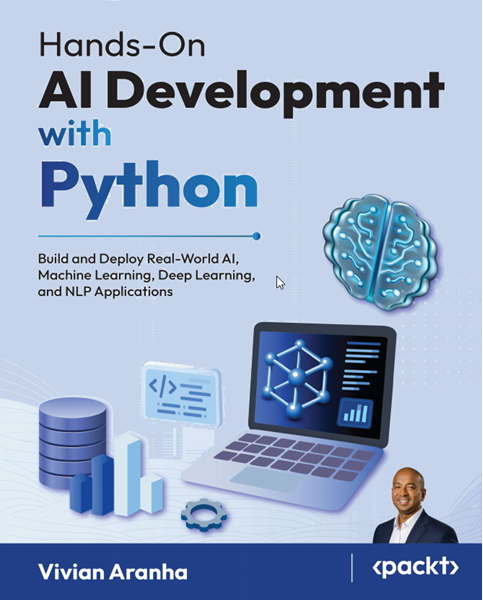
AI development is another really timely subject. I recently read Hands-On AI Development with Python: Build and Deploy Real-World AI, Machine Learning, Deep Learning, and NLP Applications as a review copy I received from my friends at PackT.
Author
Vivian Aranha is described as an AI educator, technology leader, and founder of School of AI. He was worked with Fortune 500 organizations including The Washington Post, Delta Air Lines, and IBM. He currently teaches globally through School of AI, Udemy, Skool, and Maven.
Hands-On AI Development with Python
There are plenty of books that promise to teach you artificial intelligence, but many of them leave you somewhere between I understand the theory and OK, but how do I actually build something? This book is aimed at closing that gap. It takes a practical approach, moving from Python fundamentals through machine learning, deep learning, natural language processing, computer vision and, eventually, deploying AI applications.
What I particularly liked about the book is that it doesn’t assume the reader already knows everything about machine learning. It starts at a fairly accessible level, covering Python basics, NumPy, pandas, data manipulation and exploratory data analysis before moving into machine learning models. That order makes sense. AI can sometimes be presented as if you can jump straight into neural networks and large language models, but the reality is that understanding data and being comfortable with the underlying programming environment are pretty important.
The practical nature of the book is its biggest strength. Rather than spending chapter after chapter explaining concepts in isolation, Aranha repeatedly follows explanations with code and projects. The early chapters cover things such as linear regression, classification, spam detection and neural networks, while later projects become considerably more ambitious. There are examples involving image classification, sentiment analysis, fake-review detection, named entity recognition, recommendation systems and even a Tic-Tac-Toe AI using the minimax algorithm.
I think that hands-on approach will appeal particularly to people who learn by doing. Vivian recommends working through the examples interactively rather than simply reading them, modifying the code and attempting the projects independently before looking at the solutions. That is good advice, and it reflects the overall philosophy of the book.
I appreciated the breadth. The book doesn’t limit itself to one particular corner of AI. After establishing the basics, it moves into TensorFlow and neural networks, NLP and pre-trained models, then into deployment with Flask and cloud platforms. Later chapters introduce CNNs, recommendation systems, collaborative filtering, AI games and a simple voice-controlled personal assistant.
For someone trying to get a feel for the AI development landscape, that makes the book quite useful. You can move from What is machine learning? to actually building something, then see how different techniques are applied to different types of problems. I also liked the fact that deployment isn’t completely ignored. Chapter 4 takes a model and turns it into a web service using Flask, which is an important step that introductory AI books sometimes gloss over.
Limitations?
The breadth does come with a downside, though. Personally, I sometimes found the book’s scope a little ambitious. There is a lot packed into these pages. The transition from basic Python programming to machine learning, neural networks, NLP, computer vision, recommendation engines and AI applications means that individual topics don’t always have the space they might receive in a specialist book. If you’re looking for a deep theoretical treatment of neural networks or a detailed exploration of modern generative AI architectures, this probably isn’t that book.
But I don’t think that is really the book’s purpose. Vivian is much more interested in giving readers a broad practical foundation and getting them comfortable with building things. The book itself describes AI as a combination of programming, mathematics, data manipulation and software engineering rather than an isolated skill, and I think that is an important point.
Intended audience
The intended audience is also fairly clear: software developers, data scientists, students, self-taught practitioners and technical professionals. A basic familiarity with Python is recommended, but previous machine learning experience isn’t required because the material builds progressively.
I came away from Hands-On AI Development with Python thinking of it less as a definitive reference book and more as a practical launchpad. Its real value is in encouraging the reader to stop just reading about AI and start experimenting with it.
If you’re already an experienced machine learning engineer, some of the introductory material will probably feel very familiar. But if you’re a developer, analyst, student or technically minded professional wanting to move from understanding AI concepts to actually building AI applications, there is plenty here to keep you busy.
Summary
What makes the book work is that it doesn’t try to make AI mysterious or unnecessarily intimidating. Instead, it breaks the subject into manageable pieces, gives you code to work with, and gradually increases the complexity. In a field that can sometimes feel overwhelmingly broad, having a book that simply says let’s build something is a pretty useful place to start.
8 out of 10
2026-10-07