
Book Review: Azure SQL Hyperscale Unveiled
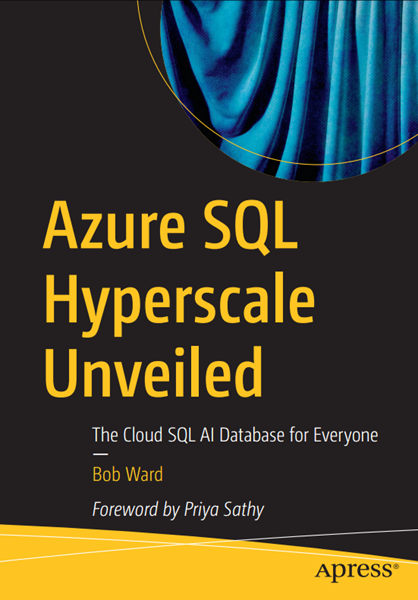
So much of my recent work has been around Azure SQL Database, and Fabric Warehouse. But in terms of Azure SQL Database, the Hyperscale tier is the one I haven’t used as much. So I was pleased to see a new book from an old friend (Bob Ward from Microsoft) that covers it. Azure SQL Hyperscale Unveiled: The Cloud SQL AI Database for Everyone .
Author
Bob Ward is a Principal Architect for the Microsoft Azure Data team that owns the development of Microsoft SQL. I’ve been involved with SQL Server since 1992 and Bob is one of the few people at Microsoft that I can recall having been there pretty much the whole time. Bob knows what he’s talking about with both SQL and with baseball. (I’ve enjoyed discussing that with him over the years).
Azure SQL Hyperscale Unveiled
I’ve read plenty of books that explain what a database product can do. Far fewer make me understand why it was built the way it was. That is what I like most about this book. Bob doesn’t simply give us a list of features. He explains the problems Microsoft was trying to solve, the decisions behind the architecture, and what those decisions mean for people building and running SQL applications. I think that makes this book worth reading even if you have no immediate plans to use Hyperscale.
The main argument is clear from the start. Bob says that Hyperscale should not be seen as a special option for enormous databases. Bob believes it is a sensible place to start with a small database and keep growing. I can see the appeal. Separating compute, storage, and transaction log processing removes some familiar SQL Server headaches. The reason I haven’t done that in the past, is that the hyperscale tier was often far more expensive than the equivalent DTU-based tiers.
The best chapter in the book is the one on architecture. The explanations of page servers, the log service, caches, and replicas show just how different Hyperscale is behind the scenes, while still keeping the SQL Server engine that developers know. The diagrams help, although some are busy enough that I would want the digital copies beside me. I bought the eBook edition of this book and that’s helpful with these. I’m not sure how that would go in the print edition.
I also like that Bob doesn’t leave the architecture as theory. The book uses a fictional hospital application, Ward General, and keeps building on it. We see a database deployed, an application connected to it, and then security, monitoring, availability, and performance added as the story moves forward. The accompanying GitHub examples are a great addition. I particularly liked the use of T-SQL and DMVs to show what the system is doing. That is far more useful to an experienced SQL professional than another set of marketing diagrams.
The book covers a surprising amount about AI. The hospital application grows to include vector search, AI assistance, and an agent using MCP and stored procedures. This could easily have become a collection of hype but the design choices are thoughtful. In particular, Bob shows the value of giving an agent a limited set of known database operations rather than allowing it to invent whatever SQL it likes. He also includes human approval in the workflow. Those are practical ideas, not just an AI demonstration.
Choosing a database is also about cost, workload shape, existing systems, and what you give up. The book does cover pricing ideas, migration issues, and differences from SQL Server, including the lack of cross-database queries, SQL Server Agent, and linked servers. Even so, I would have liked a tougher comparison with other Azure SQL options and more clear examples of when Hyperscale would be the wrong choice. Not every application needs this architecture, and not every team will want the extra cost of replicas or added cloud services.
I was so pleased that the later chapters give real attention to the unglamorous but essential work of watching performance, securing data, handling failover, and restoring databases. The discussion of snapshot-based backups is especially good. The performance chapter is also useful, covering scaling compute, named replicas, and query processing improvements without suggesting that scaling up can fix every bad query.
Limitations??
Unsurprisingly, not many. I didn’t expect many.
That said, I think the AI material takes up more room than some readers will want. I was fine with it, but if your main interest is operating and tuning a database, you may find yourself wishing for more time on everyday workload behaviour and less on building a clinical application. The examples also lean heavily on VS Code, GitHub Copilot, and supporting scripts. Bob makes the code available for manual use, but the setup is not always as simple as the friendly writing style suggests. This is a book to work through, not a book where every example can be tried in five minutes.
Bob is clearly proud of Hyperscale, and he has every reason to be. His long involvement with SQL Server gives him a view that most authors simply cannot offer. But I can imagine that phrases such as for everyone and Azure is the best cloud for SQL will no doubt get pushback from some people.
Summary
I recommend this book strongly to SQL Server professionals who want to understand where Microsoft’s cloud database architecture is heading. It is not some sort of independent buyer’s guide, and readers should keep their critical judgement switched on. But as an inside explanation of Hyperscale, backed by practical examples and written by someone who knows the engine deeply, it is hard to beat. I finished it thinking less about how large my next database might become, and more about how much the underlying architecture can change what is possible.
9 out of 10
2026-11-13