
Book Review: AI Ethics in Action
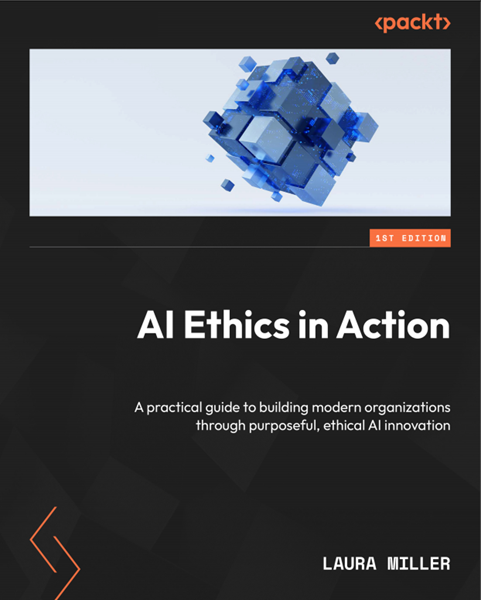
AI Ethics is a really timely subject. I recently read AI Ethics in Action: A practical guide to building modern organizations through purposeful, ethical AI innovation as a review copy I received from my friends at PackT.
Author
Laura Miller is described as a continental philosopher and AI ethicist. She works across many continents and is recognized by publications like The New York Times. Laura founded Aeterne and Mindher. I liked seeing that her advisory clients included NIST, the US State Department, and the EU AI Act Public Working Group. Laura is well-positioned to write this book.
AI Ethics in Action
There are plenty of books about artificial intelligence that leave you feeling either overwhelmed by what AI might become or slightly guilty that you aren’t doing enough about it. Laura Miller’s book takes a different approach. She isn’t pretending that ethical questions around AI are simple, or that there is a single checklist that will magically make an organization ethical. I liked her approach that is way more practical: we need to get better at making decisions.
It’s one of the things I liked most about the book. Laura writes about ethics in a way that feels considerably more accessible than much of the academic literature on the subject. She introduces philosophical concepts such as consequentialism, deontology and virtue ethics. Now that sounds like it could be overwhelming but she doesn’t leave these concepts floating around as abstract ideas. She connects them to decisions that organizations are actually making about data, risk, privacy, AI deployment and accountability.
One of the most useful parts of the book comes when she starts building practical frameworks around these ideas. Laura introduces a risk-based framework for developers, a rights-protection framework for those deploying AI, and a relational framework that considers the quality of information and the relationship between people and technology. These are then brought together in the broader idea of a supraframework.
I liked this emphasis on frameworks because it addresses a problem I see frequently in discussions about AI ethics: everyone agrees that ethics is important, but it can be much harder to translate that agreement into an actual decision-making process. Laura tries to solve that problem with practical tools including SMART goals, measurable ethical metrics, procurement considerations and a 30-60-90-day AI adoption plan.
That’s a great practical and useful addition.
The scope of the book is also impressive. Laura doesn’t restrict AI ethics to the familiar topics of bias, privacy and transparency. She explores intellectual property, liability, cybersecurity, misinformation, employment, environmental impacts, governance and the unequal distribution of technology. The later chapters take this even further by looking at global AI governance and the way AI can reinforce existing social and structural inequalities.
For me, though, the most compelling part of the book is its discussion of doing good enough. That phrase initially sounds a little uncomfortable when attached to ethics. Surely we should be aiming for the best possible ethical outcome? But her point is more nuanced. Ethical decision-making happens in the real world, where information is incomplete, resources are limited and decisions have to be made. Waiting for the perfect answer can itself become a failure to act.
The case studies reinforce this idea nicely. The final chapter presents scenarios involving tokenisation, cybersecurity and AI-generated misinformation. The Identity lost case was particularly interesting and relevant today. An LLM invents a fictitious son for business thinker Dorie Clark, demonstrating how AI can create problems that go well beyond simple factual errors. An AI system can potentially affect someone’s reputation or identity by confidently presenting information that never existed.
I also appreciated that Laura doesn’t simply provide the answers to these cases. Instead, she asks readers to work through them. That makes the book feel more like a practical workshop than a traditional textbook.
Limitations ?
Not much. If I have a criticism, it is that the book sometimes tries to cover an enormous amount of territory. There are moments when I felt that an idea had only just become interesting before the book moved on to another framework, issue or example. The breadth is a strength, but it can also make the book feel a little sprawling. Laura even acknowledges the messy nature of ethics and describes the book as the product of a non-linear process of collecting and connecting ideas.
Ultimately, I came away from AI Ethics in Action thinking that its most important contribution isn’t a particular framework or checklist. It is the mindset behind them. Laura wants readers to stop treating ethics as something that happens after the technology has been built, or as a compliance exercise imposed by regulators. Instead, ethics should influence the decisions made from the very beginning.
Summary
This is a useful book for anyone involved in AI, particularly people who have to make decisions about adopting or deploying the technology rather than simply reading about it. It doesn’t promise easy answers and thankfully, it doesn’t pretend they exist. What it does provide is a practical way of asking better questions, recognizing who might be affected, and making more considered choices. In a field moving as quickly as AI, that may be one of the more useful things a book on ethics can offer.
9 out of 10
2026-10-15