
Opinion: When did "it almost worked" become acceptable?
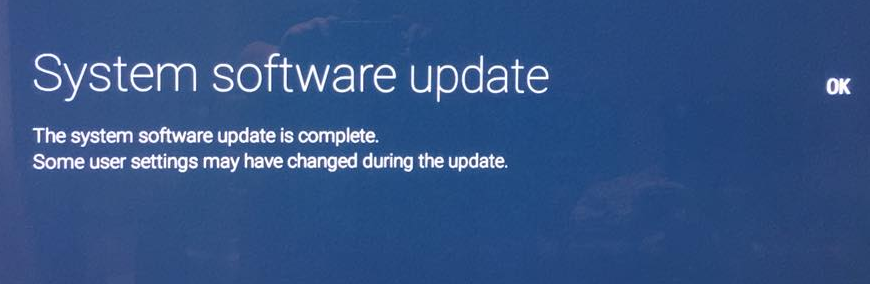
Perhaps I’m getting old and philosophical but I recall the days when the IT industry prided itself on accuracy. We worried when things didn’t work properly and kept working on them till they did work.
If a customer’s system stopped in a weird way, they actually wanted to know why. They didn’t just want to reboot it and hope for the best.
When did that change?
In a previous blog post , I’ve wrote about the evil Oops something went wrong syndrome that seems to have infected many Sofware as a Service applications.
Sony example
The screenshot above though, is the outcome after a Sony TV performed its routine software upgrade. Let me paraphrase it’s message for you: What it basically said is:
I did an upgrade for you. Nothing went wrong but I think I trashed some of the configuration settings that you’d made but I’m not going to give you any clue about which ones, and you’ll just have to suck it and see what’s changed.
What an awesome message, and one that really doesn’t match the advertising slogans:

I’m guessing they’re still quite a distance from perfection.
Apple example
But Sony is not alone on this. A little while ago, I upgraded my Apple iPhone. The recommended method at the time was to back it up to iCloud, then restore it onto the new phone, or at least that’s what the genius (Apple terminology) told me at the store.
Why they couldn’t just transfer the data directly between the old and new phones at the store immediately was far from obvious, particularly when a phone now costs so much. As phones get larger (storage-wise), sending all the data from one up to a cloud storage, and then back down to the new one seemed patently silly. (At least they’ve recently fixed this and the two phones can communicate directly with each other for the cloning).
When I did it back then via the cloud though, the backup was reasonably quick. The restore, however, took over 3 days and when it finally ended, it said:
Some files weren’t restored.
No hint, no clue about what. Just some stuff went missing and the phone thought I’d better give me a heads-up.
How did we get to a point in the industry where a 3 day restore that ends in something didn’t get restored is considered acceptable in a professional product?
Microsoft example
Mind you, I’m not sure that’s any better than Microsoft-related updates that simply ignore your previous settings and put the device, or browser, etc. back to whatever state the update wants it to be in. I’m sure it’s easier to apply updates when you don’t care about preserving the intent of previous configuration changes.
I’ve given up using Edge primarily because I feel like I have little control over what it displays. I do a lot of presentations and demonstrations, both in meetings and in online sessions. I want a blank browser to use: no adds, no widgets, no news feeds, nothing. It’s increasingly difficult to achieve this with Edge. And when you do, it happily just decides to change your settings in the next update. Something suddenly reappears on what should be a blank screen. I don’t have this issue with Chrome and so I use it or other browsers, even with all their limitations.
But I can open up Edge in a professional meeting or webinar, and suddenly I find they’ve put something like the MSN news feed back onto my browser screen. That wouldn’t be all that bad, except the MSN hope page invariably has at least one image of a scantily-clad woman. MSN might decide that’s ok but it’s just not acceptable in a professional session. Microsoft needs to do better. And MSN is a rubbish news feed anyway.
2026-09-25