
Book Review: Serverless ETL and Analytics with AWS Glue (2nd Edition)
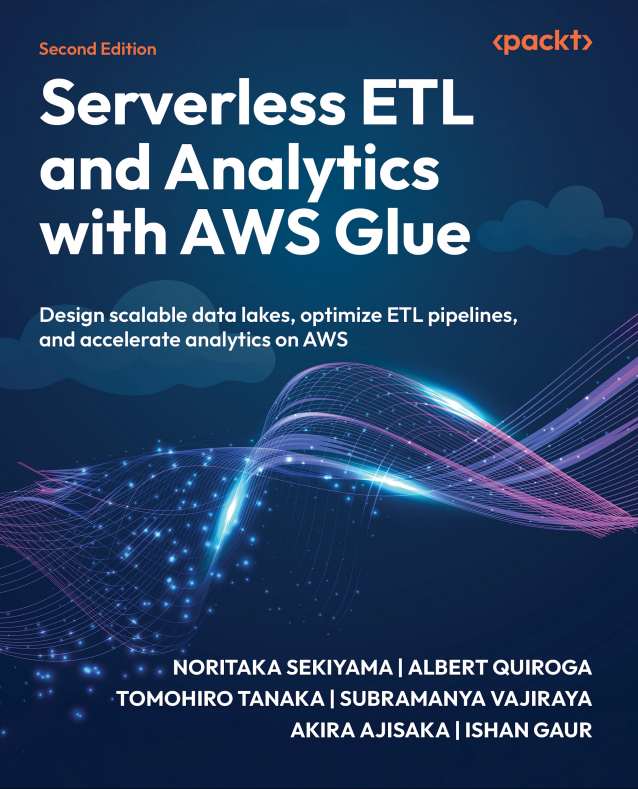
I recently read the 2nd edition of a book on serverless ETL. Serverless ETL and Analytics with AWS Glue (2nd Edition) . I hadn’t had the chance to read the first edition of this book, but my friends at PackT sent me the 2nd edition to check out.
Authors
Noritaka Sekiyama is a big data engineer working at a data and AI company.
Albert Quiroga is a senior solutions architect at Amazon.
Tomohiro Tanaka is a big data specialist with particular expertise in data infrastructure.
Subramanya Vajiraya is a senior cloud engineer here in Australia at AWS Sydney.
Akira Ajisaka is an experienced software engineer and OSS contributor.
Ishan Gaur is a very experienced software developer, data engineer, and cloud architect.
Serverless ETL and Analytics with AWS Glue (2nd Edition)
This book is an ambitious and impressively broad guide to building modern data platforms on AWS. It doesn’t just treat AWS Glue as an ETL service. Instead, the authors position it as one component in a much larger data engineering ecosystem. I like the way it follows the lifecycle of data from ingestion and preparation through governance, security, orchestration, monitoring, troubleshooting, analytics, and cost management.
It starts by providing context for readers who are still becoming familiar with contemporary data architectures. The authors cover the usual suspects: OLTP and OLAP, data warehouses, data lakes, lakehouses, data mesh, distributed computing, Apache Spark, and the core AWS Glue services before they moved into ingestion and transformation. I can imagine that many readers, particularly experienced data engineers, might wellskim some of this material, but I did appreciate the way it establishes a consistent vocabulary for the more detailed chapters that follow.
The book has strong operational coverage. There are chapters on data layouts, metadata management, security, data sharing, and pipeline management that address the areas that are often the difference between demonstration and a production system. Later in the book, they cover monitoring and troubleshooting. I liked the way the authors explain a repeatable diagnostic process using observability metrics for AWS Glue, CloudWatch, logs, and the Spark UI, and then apply it to problems such as out-of-memory errors, permission failures, and S3 throttling. These are exactly the issues that tend to come up after an engineer has their first successful Glue job gone into production.
The book has a practical orientation. I’m not a big fan of books with multiple authors but in this case, it works quite well because the material is broad and ranges across architecture, operations, Spark, security, and governance. None of those areas feel like an afterthought.
I am a fan of walkthroughs and the book has many. There are walkthroughs for AWS Glue workflows, Step Functions, infrastructure provisioning, change data capture, partition indexes, variable workload sizing, and a multi-account DataOps pipeline. The chapter on end-to-end development lifecycle is a standout, taking readers through CDK, local development with Docker, unit and snapshot testing, and promotion through CodePipeline. That emphasis on repeatability and engineering discipline makes the book more useful than a collection of console tutorials.
I thought the discussion on open table formats, with Apache Iceberg, Apache Hudi, and Delta Lake were particularly useful. They were discussed both conceptually and through hands-on examples. Machine learning and generative AI integration are included as well, particularly SageMaker and Amazon Q, while the final chapter on cost optimization provides a sensible conclusion by connecting Glue’s consumption-based pricing with monitoring, resource tuning, observability costs, and governance.
Limitations
A book this broad will always have limitations. This book is already fairly long yet some topics could support books of their own. If you’re looking for deep coverage of Spark internals, Iceberg architecture, or machine learning, you’ll need additional resources.
Given the intended audience, it’s probably ok but the book is also very AWS-centric, and its many console steps, service integrations, and rapidly evolving features mean that individual screens and options are likely to age faster than the architectural guidance. It is best suited to readers who already understand basic AWS concepts; familiarity with Python, SQL, or Spark will also make the examples easier to follow.
Summary
I can’t comment on the change from the previous edition, but this edition is a strong practical reference for data engineers, ETL developers, cloud architects, and analytics professionals working in the AWS ecosystem. Its real value lies not just in teaching Glue features, but in showing how those features fit together into a secure, observable, maintainable, and cost-conscious data platform. For anyone moving beyond introductory Glue experiments toward production-scale data engineering, this is a comprehensive and worthwhile guide.
8 out of 10
2026-09-05