
Fabric RTI 101: Hybrid Architectures

In practice, most real-time systems use a combination of streaming and batch processing rather than relying entirely on one or the other. This approach is often described as a hybrid architecture, where each path serves a different purpose.
The hot path (also called the streaming path) handles data as it arrives. It’s designed for immediacy, enabling rapid decisions such as triggering alerts or applying automated actions. The trade-off is that it usually works with limited context and may rely on approximations or rolling summaries.
The cold path (or batch path) processes data after it’s been stored. It’s slower but more thorough, using complete datasets to perform detailed analysis, train models, or validate earlier real-time insights.
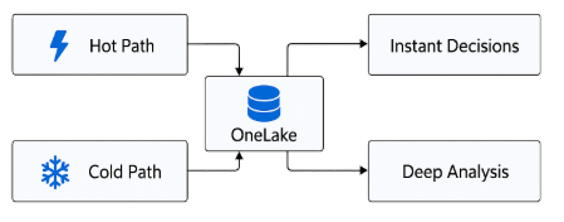
In Microsoft Fabric, both paths can be unified within OneLake, allowing a single storage and governance layer that supports both streaming (Eventstream and KQL databases) and batch analytics (Lakehouse and Warehouse).
Two common design patterns describe how these paths interact:
- The Lambda architecture, which combines both batch and streaming layers. The batch layer provides accuracy, while the streaming layer offers low latency.
- The Kappa architecture, which simplifies this model by using a single streaming layer that can replay historical events for reprocessing when needed.
Choosing between these patterns depends on the use case. Some solutions prioritize immediacy, such as detecting fraud or operational issues in seconds, while others emphasize accuracy, such as financial reporting or audit processes. The goal is to find the right balance between the two.
Learn more about Fabric RTI
If you really want to learn about RTI right now, we have an online on-demand course that you can enrol in, right now. You’ll find it at Mastering Microsoft Fabric Real-Time Intelligence
2026-09-04