The Bit Bucket

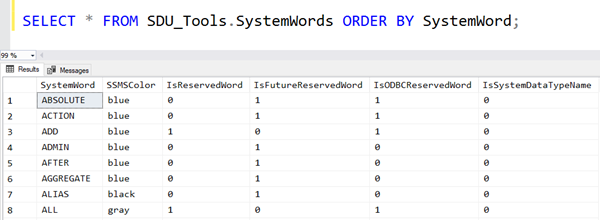
SDU Tools: Find columns that shouldn't have time

SDU Tools: Find columns that shouldn't have time

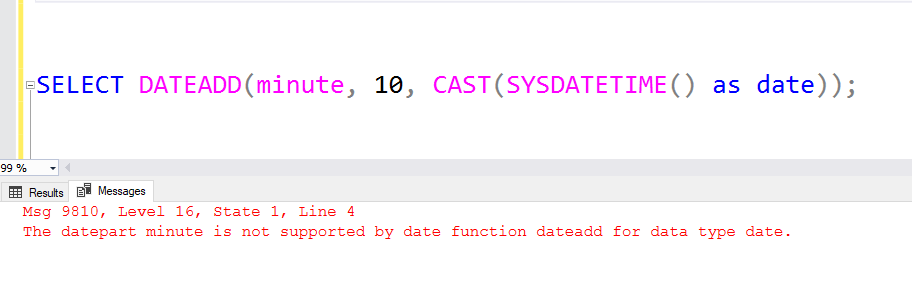
Ever since I started working with SQL Server back in 1992, the #1 requested feature that I kept hearing about was a separate date data type. SQL Server had a smalldatetime and a datetime but these included both date and time within the same type.

Having date and time often led to odd bugs or performance issues, where people didn’t realize that times were included and tried to work with the values as dates.

2018-01-17

Opinion: Avoid Unneces Abbrevs

Opinion: Avoid Unneces Abbrevs

Many database developers (and other developers) seem to regard the endless use of abbreviations as some badge of honor. Don’t be one of these people.

Avoid abbreviations almost all the time.

I’ve written before about my dislike for the EOMONTH T-SQL statement. Given the same version introduced names like DATETIMEOFFSETFROMPARTS, surely we didn’t have to save 3 characters and could have had ENDOFMONTH. (I heard it was named this way to match the Excel function but matching something from another language that was created a long time ago isn’t the right answer here).

2018-01-16

SQL: Newbie Mistake Number 1: Using float instead of decimal

SQL: Newbie Mistake Number 1: Using float instead of decimal

When I’m looking at a database schema for the first time, there are a number of tell-tale signs that give me the hint that the developers really haven’t done much work with SQL Server before. They’ve made a “newbie” mistake.

One of those is the extensive use of the float data type.

Most times that I see this, the developers have come from a C or Java background and they assume that something that needs a decimal point in it, needs to be float. There are some situations where float makes sense, but 99% of the time what they should have used was decimal.

2018-01-15

DevOps: Load Tests Need to be Part of Your Regular Deployments

DevOps: Load Tests Need to be Part of Your Regular Deployments

One of the principles of DevOps is that you should be able to deploy regularly, with smaller low-risk changes. This addresses a key problem that I see in many sites:

  • Each code release is large
  • The code is difficult to test
  • Code merges are painful
  • Deployments take a long time
  • Deployments often fail
  • Deployments are considered to be high-risk procedures

The end result of this situation is that deployments are avoided and then a snowball effect occurs where:

2018-01-12

SSMS: Using Snippets in SSMS to Improve the Drop Database Statement

SSMS: Using Snippets in SSMS to Improve the Drop Database Statement

In an earlier post, I showed how to create a DROP DATABASE template in SQL Server Management Studio (SSMS). At the time, I mentioned that a template wasn’t the best option because a command like this is normally inserted into a script; it’s not the whole script.

That’s where snippets shine. Let’s create a snippet for it.

First let’s open Code Snippets Manager (Tools > Code Snippets Manager):

You’ll see the existing snippet folders. I’ve clicked Add, then created a new folder called GL_Snippets.

2018-01-11

SDU Tools: Listing all the Data Types Used in a SQL Server Database

SDU Tools: Listing all the Data Types Used in a SQL Server Database

When I first start to work with a database that I haven’t seen before, one of the things that I check immediately is the type of data being stored. The list of existing data types often gives me interesting insights into the design of the database, and how it interacts with application code.

The list of data types also shows me details of the consistency (or lack of) in the design.

2018-01-10

SSMS: Creating T-SQL Templates in SQL Server Management Studio (SSMS)

SSMS: Creating T-SQL Templates in SQL Server Management Studio (SSMS)

A few weeks back, I mentioned how useful templates can be. I said that I’d discuss how to create them later. Well that’s today.

I thought I’d take dropping a database as an example. The supplied template doesn’t work for me, so let’s create a new one.

Note: SQL Server 2016 SP1 introduced DROP DATABASE IF EXISTS but I find that option quite useless. It fails if anyone is connected to the database. And to disconnect people beforehand, you need to first check if it exists, so the statement is pointless.

2018-01-04

SDU Tools: Determining Leap Years in T-SQL with IsLeapYear

SDU Tools: Determining Leap Years in T-SQL with IsLeapYear

Is 2018 be a leap year?

Was 2000 a leap year?

Will 2100 be a leap year?

When I was a young student at school, we learned that leap years were every four years. Then as I got older, I learned that there was more to it than that.

It’s important to understand that any calendar is just an approximation, and there is a lot more to calendars than most people realize.

2018-01-03

Opinion: If you can't type, you are writing worse code than if you could

Opinion: If you can't type, you are writing worse code than if you could

Let me make a potentially bold statement:

People who can’t type write worse code than they could be writing

I’m sure that will upset some people (probably those who can’t type or who are two or four finger typists) but it’s a conclusion that I’ve come to over many years. Coding is clearly not the same thing as typing but the reason is simple:

To write good code, you need to be prepared to constantly refactor and rework the code that you write, and if you can’t do that quickly, you’ll be more reluctant to do it.

2018-01-01

SDU Tools: Converting T-SQL Strings to Snake Case and Kebab Case

SDU Tools: Converting T-SQL Strings to Snake Case and Kebab Case

In a recent blog post, I described converting strings to Proper Case and Title Case. And more recently, I described how to convert them to Pascal Case and Camel Case.

The final option (for now) in this set is conversion to Snake Case and Kebab Case.

In Snake Case, all words are lower-cased, then all spaces between words are replaced by underscores.

You can see it in this example:

2017-12-29