
Book Review: Python Data Analysis
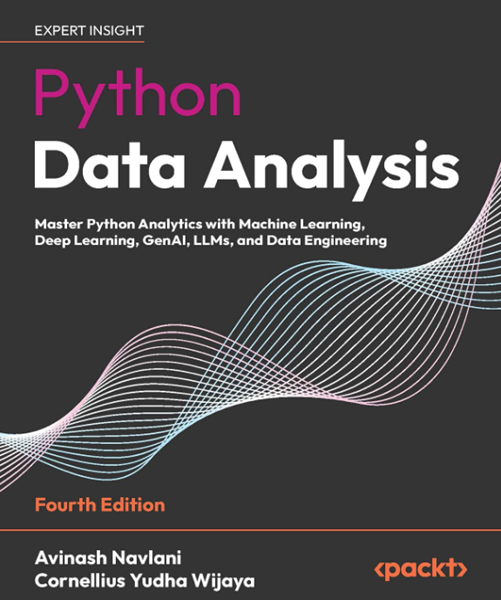
I recently received a review copy of Python Data Analysis: Master Python Analytics with Machine Learning, Deep Learning, GenAI, LLMs, and Data Engineering by Avinash Navlani and Cornellius Yudha Wijaya from my friends at PackT. This is the fourth edition of this book.
Authors
Avinash Navlani is a senior data scientist, researcher, and educator with a PhD in data science and many years in both the industry and in academia.
Cornellius Yudha Wijaya is a data science manager leading AI initiatives and driving the development of practical data and AI solutions.
Content
This is a large book; larger than I was expecting. It’s a guide to the increasingly broad world of data work with Python. The professional experience of the authors is apparent. Although its title suggests a conventional treatment of data manipulation and visualisation, the book reaches much further, covering statistics, machine learning, deep learning, natural language processing, image analysis, generative AI, parallel computing and PySpark. The strongest part is the way that it presents these subjects as parts of an end-to-end analytical workflow rather than as a disconnected catalogue of libraries.
The book starts with the foundations. Readers are introduced to common analytical processes, the Python tooling landscape, NumPy, pandas, statistics and linear algebra before moving into visualisation and data preparation. This ordering is important. Too many introductory books rush towards predictive models without first explaining how to understand, clean and transform the underlying data. Here, the chapters on retrieving data, dealing with missing values and outliers, feature engineering and time-series preparation reinforce the less glamorous but essential work that precedes useful modelling.
As well as reading data from familiar formats such as CSV, Excel, JSON and Parquet, the discussion also extends to relational and NoSQL databases, APIs, AWS S3 and Azure Blob Storage. Visualisation progresses from Matplotlib and Seaborn to interactive Plotly charts and Dash dashboards. Later chapters introduce supervised and unsupervised learning, ensemble techniques, neural networks, text and image processing, LLMs, Dask, Modin, Ray and PySpark.
Once again, it was good to see downloadable code that supports the examples, making the book most valuable when read beside a working Jupyter or Visual Studio Code environment.
This breadth is also the book’s main limitation. No single volume can explore all these areas deeply, and the later chapters are best viewed as practical introductions rather than complete treatments. Readers hoping to master deep learning, LLM fine-tuning or distributed Spark engineering will need more specialised resources afterwards. Similarly, despite the progressive structure, this is not really a first book on programming. Basic familiarity with Python is assumed, and the advanced material will be easier for readers who already understand elementary statistics and machine-learning concepts.
The teaching style is direct and example-driven. Concepts are usually followed quickly by code, output and interpretation, which helps readers connect theory with implementation. The model-evaluation examples are particularly useful because they encourage comparison rather than merely showing how to fit an algorithm. Chapters conclude with summaries, although the book would be stronger with more structured exercises, review questions or larger projects that integrate techniques across several chapters.
I was reading an early-review copy, and it occasionally contains awkward phrasing, inconsistent capitalisation and terminology that could benefit from another editorial pass. But these issues are minor. Given the book’s size and range, readers may also prefer to treat it as both a guided course and a reference, selecting chapters according to their immediate needs.
Summary
This book provides a substantial and useful survey of modern Python analytics. It is particularly well suited to analysts, developers and students who know some Python and want to connect data preparation, visualisation, modelling and scalable processing into a solid workflow. Its best value is in showing how the many pieces of today’s Python data ecosystem fit together. For readers seeking a broad, hands-on route from pandas to machinehg learning, generative AI and big-data tools, it provides an excellent starting point and a useful desk reference.
8 out of 10
2026-07-21