
Fabric RTI 101: Edge Scenarios
Edge computing plays a key role in modern real-time data architectures by moving some processing closer to where data is generated. Instead of sending every raw data point to the cloud, devices or gateways at the edge can handle local filtering, aggregation, and enrichment.
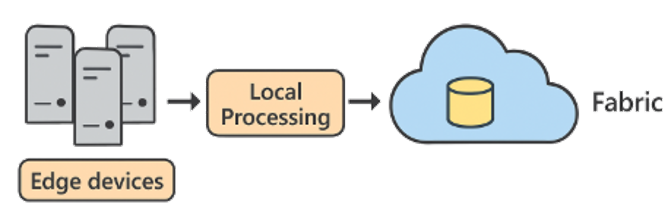
Using Azure IoT Edge or similar frameworks, organizations can deploy lightweight processing modules directly on devices, gateways, or factory controllers. These modules can execute logic such as:
- Filtering out noise or redundant data
- Aggregating sensor readings into summaries
- Running basic anomaly detection or rule-based alerts locally
This approach has several benefits. It reduces bandwidth by only transmitting relevant or summarized data, lowers cloud processing costs, and improves resilience in cases where connectivity to the cloud is intermittent or limited.
The combination of edge and cloud processing forms a hybrid model. The edge handles immediate, localized decisions and data conditioning, while the cloud - through Fabric - manages large-scale analytics, integration, and long-term data storage.
This model is widely adopted in IoT-heavy industries such as manufacturing, energy, logistics, and smart infrastructure, where near-real-time responses are critical but full connectivity cannot always be guaranteed.
Edge scenarios extend the real-time intelligence pipeline by ensuring that insights can be generated and acted upon even when the cloud isn’t directly reachable, maintaining operational continuity and efficiency.
Learn more about Fabric RTI
If you really want to learn about RTI right now, we have an online on-demand course that you can enrol in, right now. You’ll find it at Mastering Microsoft Fabric Real-Time Intelligence
2026-10-28