
Book Review: The Definitive Guide to Power Query (M)
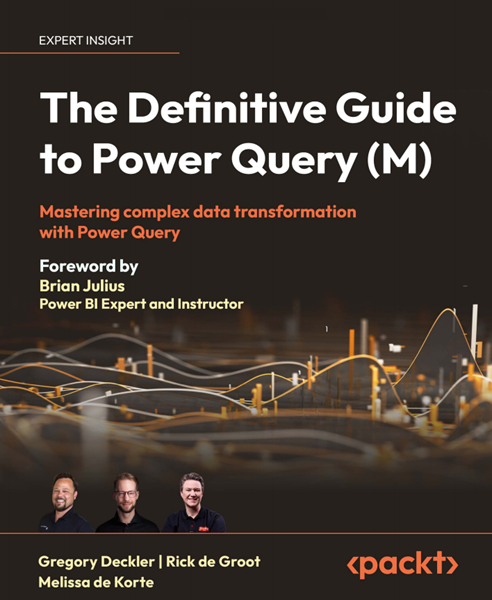
In previous reviews, I’ve mentioned that I spend much of my time nowadays working with Microsoft Fabric but in many of those projects, I still regularly need to use Power Query. Doing that effectively means using the M language. I was pleased to receive a review copy of The Definitive Guide to Power Query (M) from my friends at PacktT.
Authors
Gregory Deckler is a fellow Microsoft Data Platform MVP, actibe blogger and Fabric/PowerBI community member. He is the author of many books on related topics.
Rick de Groot is Power BI consultant, blogger, YouTuber and author with a background in finance. He has devoted many years to building expertise on M.
Melissa de Korte is described as a passionate problem-solver, known for simplifying complex problems by using Power Query.
The Definitive Guide to Power Query (M)
Power Query is one of those tools that many people use every day without really understanding how much it can do. Most users are happy clicking buttons to clean up their data, and there’s nothing wrong with that. But there’s a lot more power hiding behind those buttons. That’s where The Definitive Guide to Power Query (M) comes in, and I think it fills an important gap in the market.
The three authors clearly know their subject. More importantly, they do a great job at explaining it. M, the language behind Power Query, isn’t always easy to learn, and the documentation can be hard going. Many developers have never worked with functional programming languages before. This book makes a serious effort to turn a fairly difficult subject into something that ordinary data professionals can understand.
No surprise that it starts with the basics of M, including how expressions work, how data is represented, and how to write your own code. It then moves into more advanced areas such as lists, records, tables, custom functions, and working with nested data. I particularly liked the attention given to data types. It’s an area that many people skip over, but misunderstandings about types can cause all sorts of problems when transforming data.
One of the strongest parts of the book is its focus on practical problems. There are examples of cleaning difficult text, combining files, working with dates, creating reusable functions, and handling data that doesn’t arrive in a nice, simple table. These are exactly the sorts of things that people struggle with in real projects. The examples help show why learning to write M directly is worth the effort.
I was also pleased to see a substantial section on performance. Too many Power Query solutions work perfectly with a few hundred rows but become painfully slow when dealing with larger amounts of data. The discussion of query folding, buffering, and different ways to process lists is especially useful. The authors don’t just show how to make something work. They explain why one approach can be much faster than another. That alone could make the book worthwhile for experienced Power BI developers. It is still though one of the reasons that I often try to do most of my data manipulation in stored procedures where that’s possible. Too many parts of Power Query can easily become single-threaded.
The chapters on error handling, iteration, and recursion are also valuable. These aren’t glamorous subjects, but understanding them makes a big difference when you’re trying to build reliable solutions. The final chapter even covers building custom connectors, which shows just how far you can take the language.
Limitations?
Not many at all. Obviously, at over 700 pages of main content and supporting material, this is a big book, and some sections are quite heavy. The discussion of M’s type system and some of the more advanced programming concepts will challenge readers who haven’t done much coding before. I liked the level of detail but I can imagine that might get in the way of seeing the bigger picture for newcomers.
I don’t think this is a book that I’d hand to someone who has never used Power Query. There are easier places to start. But for someone who already uses Power Query and wants to move beyond the graphical interface, it’s an excellent choice.
Summary
I think the authors have delivered something genuinely useful. It’s both a learning guide and a reference you’ll want to return to when you encounter difficult problems. If you’re serious about getting more out of Power Query, this book deserves a place on your shelf.
8 out of 10
2026-10-29