
Book Review: Analytics Engineering with Microsoft Fabric and Power BI
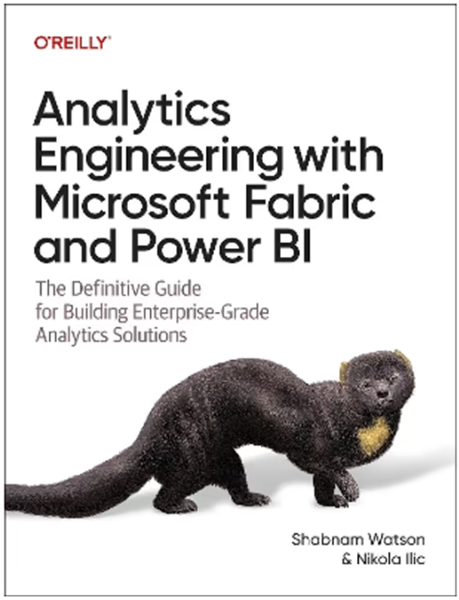
I spend much of my time nowadays working with Microsoft Fabric and there are many opinions on how to use it for the best outcomes, so I was interested to see a new book Analytics Engineering with Microsoft Fabric and PowerBI from friends of mine (in the Fabric community), Shabnam Watson and Nikola Ilic. Nikola sent me a copy to review.
Authors
Shabnam Watson is a business intelligence consultant and owner of ABI Cube, a company that specializes in delivering data solutions using the Microsoft Data Platform. She has decades of experience and is a fellow Microsoft Data Platform MVP.
Nikola Ilic is an independent data platform consultant and trainer focusing on Power BI and Microsoft Fabric. He has also been working with data for almost two decades. Nikola regularly blogs at data-mozart.com.
I was pleased to see the foreword was by Arun Ulag.
Analytics Engineering with Microsoft Fabric and Power BI
Microsoft Fabric is a big platform, and it can be surprisingly hard to work out which parts you should use for a real project. That’s the problem Shabnam Watson and Nikola Ilic tackle in Analytics Engineering with Microsoft Fabric and Power BI. They do a very good job of it.
What I like most is that this isn’t simply a tour of Fabric features. The authors want readers to understand why they are making particular choices. Should you use a lakehouse or a warehouse? Is Direct Lake really the best option for your Power BI model? When is a dataflow a better fit than a notebook or pipeline? These are questions that come up constantly on actual projects, including ones I’m working on right now, and the book gives sensible, practical answers.
The opening chapters cover the role of the analytics engineer, data architecture, and data modelling. I was glad to see this material included. Too many technology books jump straight into the tools and leave readers without a clear idea of what they are trying to achieve. Here, the basics provide a useful foundation for everything that follows.
The Fabric chapters cover moving data into the platform, working with lakehouses and warehouses, and handling real-time data. There are hands-on examples, diagrams, and explanations of what the different tools are good at. Chapter 9, which helps readers decide when to use each approach, is a particular highlight. I especially liked that the authors don’t pretend every new Fabric feature is automatically better than an older option. That particularly applied to their discussion of Direct Lake versus Import mode.
The Power BI section is also strong. It goes beyond building reports to cover semantic models, DAX, and performance. The advice on reducing model size, removing unnecessary columns, and understanding memory use is the sort of practical information that can save teams a lot of trouble. Security, governance, Git integration, and deployment get attention too. That’s important because getting a solution into production, and keeping it working, is often harder than building the first version.
I liked the real-world examples near the end. I particularly enjoyed the logistics project where the team chose a SQL-based warehouse for parts of the solution instead of using Spark just because it was fashionable. That’s what I’m doing in a project right now. That is exactly the kind of common sense I’d like to see more often in technology books.
Limitations?
Not many. The book tries to cover an enormous amount of ground, so certain topics move along rather quickly. If you really want an in-depth treatment of one area, such as DAX or real-time analytics, you will still need other resources. The writing is approachable but it’s really targeted at people who already have some experience. I think a complete newcomer to data work might find the sheer number of products and concepts overwhelming.
There’s also an unavoidable issue with any Fabric book: the product changes quickly. Screenshots, menus, and some technical details will age. This is a challenge for all of us. I’ve had days where I create a lab for a course that I’m building, and two hours later, I can’t find something on the screen that was there before. I wish I was joking. Fortunately, the focus on good design decisions should give this book a longer useful life than a basic step-by-step manual.
Summary
I think this is one of the more useful ways to learn how Fabric and Power BI fit together. It is practical, thoughtful, and willing to make recommendations without pretending there is only one right answer. I’d happily recommend it to Power BI developers, SQL professionals, and data engineers who want to build better analytics solutions rather than just learn another collection of tools.
9 out of 10
2026-10-27