
Fabric RTI 101: Integrating with Flink

Apache Flink is a distributed stream processing framework designed for real-time analytics and event-driven applications. It’s well known for its ability to handle large volumes of continuous data with stateful computation, meaning it can maintain context across many events - something that simpler streaming systems struggle with.
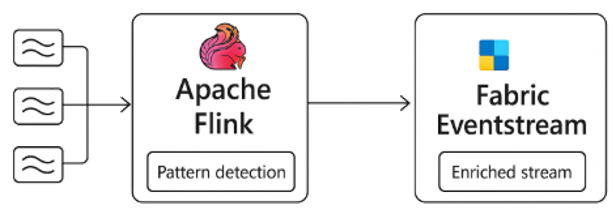
A key strength of Flink is its support for Complex Event Processing (CEP).
CEP allows you to define and detect patterns of events rather than just single occurrences. For example, you could detect a sequence such as three failed login attempts followed by a successful one, or identify correlated sensor readings that indicate a developing fault.
Flink can be deployed flexibly - it runs on Kubernetes clusters, YARN, or in managed cloud environments such as AWS Kinesis Data Analytics or Azure HDInsight. This makes it adaptable for both on-premises and cloud-based architectures.
When integrated with Fabric, Flink typically operates as an upstream processor. It performs heavy or specialized event processing, then outputs the transformed or enriched data stream to a Kafka topic, Event Hub, or similar destination. From there, Fabric Eventstream can ingest the data for further analysis, aggregation, or visualization using KQL and Power BI.
This integration approach allows teams to combine the pattern detection and low-latency stream processing strengths of Flink with Fabric’s analytical and visualization capabilities - forming a pipeline that can scale from raw event detection to business-level insight.
Learn more about Fabric RTI
If you really want to learn about RTI right now, we have an online on-demand course that you can enrol in, right now. You’ll find it at Mastering Microsoft Fabric Real-Time Intelligence
2026-10-12