
Book Review: Agentic Architectural Patterns for Building Multi-Agent Systems
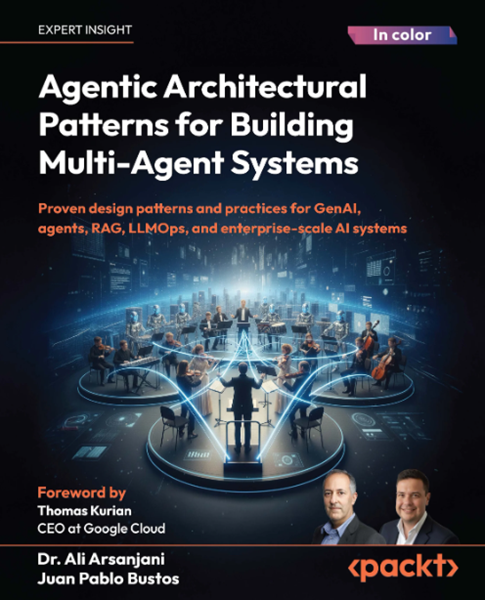
I recently received a review copy of Agentic Architectural Patterns for Building Multi-Agent Systems by Dr. Ali Arsanjani and Juan Pablo Bustos from my friends at PackT.
Authors
Dr. Ali Arsanjani is Director of Applied AI Engineering at Google Cloud where he leads a center of excellence bridging research, forward-deployed engineering, and enterprise implementation.
Juan Pablo Bustos is also currently at Google, and serves as a strategic partner to Fortune 50 corporations and global institutions. He specializes in operationalizing AI for the enterprise.
Content
This is a substantial and timely guide for anyone trying to move from generative AI experimentation to production-grade agentic systems. The authors take a deliberately architectural view of the topic, treating agents not as some sort of clever prompt chains, but as distributed systems that need structure, coordination, governance, observability, and fault tolerance.
I like the pattern-first approach that’s presented in the book. Rather than presenting agentic AI as a collection of isolated tools or framework tutorials, they give readers a vocabulary for designing systems: agent routers, supervisor and swarm architectures, blackboard-style knowledge hubs, contract-net marketplaces, consensus mechanisms, human-in-the-loop escalation, agent authentication, real-time compliance monitoring, and more. This makes the book particularly useful for architects and senior developers who need to reason about trade-offs before committing to an implementation.
The early chapters set the enterprise context. They discuss GenAI maturity, agent-ready LLMs, RAG, fine-tuning, model selection, deployment, and AgentOps. This foundation matters because multi-agent systems can easily become expensive, brittle, or opaque if teams jump straight into orchestration without thinking about data, model behavior, context, operational risk, and governance. The authors repeatedly return to the idea that production AI is not just about getting a demo to work; it is about creating systems that remain reliable under real-world pressure.
The middle section chapters on coordination, explainability, compliance, robustness, fault tolerance, and human-agent interaction are particularly useful. They address the issues that many organizations encounter after the initial excitement of agent prototypes: instruction drift, unclear accountability, weak audit trails, fragile tool calls, failures that cascade between agents, and uncertainty about when humans should intervene. The discussion is practical and enterprise-oriented, with examples that help translate abstract patterns into design choices.
The later chapters provide implementation depth through loan-processing examples and comparisons of frameworks such as Google ADK, CrewAI, and LangGraph. I was glad to see they do not pretend that one framework is universally best. Instead, they frame frameworks as implementation vehicles for deeper architectural patterns. That gives the book longer-term value, especially in a fast-changing ecosystem.
If I had to pick a limitation, it would be the breadth, but only if you’re looking for a quick fix. At over 500 pages, the book is comprehensive, but readers looking for a quick, beginner-friendly introduction may find it pretty heavy going. It also assumes you are comfortable with software architecture, Python, APIs, and basic AI concepts. Given the likely audience, I think that’s fair enough.
Solo developers or small teams might need to adapt their guidance to smaller-scale projects, as the primary target is around enterprise applications. But that’s certainly possible.
Summary
This book is a strong reference for practitioners who are serious about building reliable agentic AI. Its greatest strength is that it shifts the conversation from prompts and prototypes to architecture, governance, and production readiness. For technical leaders, AI architects, and senior engineers designing multi-agent systems, I think it will hit the spot.
I liked the book.
8 out of 10
2026-07-13