
Book Review: The New Quantum Era
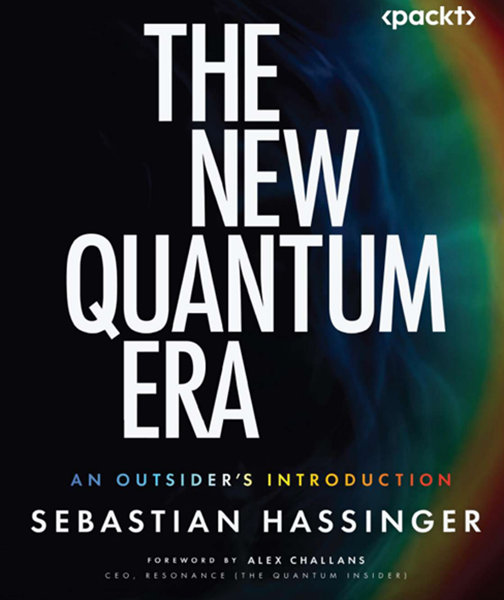
I recently received a review copy of The New Quantum Era: An Outsider’s Introduction by Sebastian Hassinger from my friends at PackT.
Author
Sebastian Hassinger has held key positions at Apple, IBM, and AWS. He is now an independent consultant and advisor. You can find him on The New Quantum Era podcast.
Content
This is a rare kind of technology book: ambitious, historically grounded, technically serious, and still readable for people who do not have a physics degree. And Sebastian is well placed to write it. He’s had both insider access and outsider sympathy.
This is not a textbook, does not teach quantum programming, and contains virtually no mathematics or code. Instead, the author aims to give readers enough conceptual understanding to interpret scientific claims, marketing claims, and investment hype with more confidence. That’s its first strength. So many quantum books either oversimplify the science into misleading metaphors or bury the reader in formal language. Sebastian takes a third path: he builds context patiently through history, personalities, institutions, business incentives, and the gradual convergence of physics and information theory.
The structure works well. The three broad movements - Theory, Reality, and What We Know and What We Don’t take the reader from Google’s quantum supremacy announcement through the foundations of quantum mechanics and information theory, then into Shor’s algorithm, qubit technologies, hype, fault tolerance, and the uncertain future. The result is less a manual than a guided tour of how a field becomes an industry before it has fully become a technology.
The most valuable sections are the ones that puncture easy narratives. The author is especially good on the disproving the common misconception that quantum computers simply try all possible solutions simultaneously. He explains why that idea is not just imprecise but actively harmful, because it supports inflated claims about quantum computing’s near-term usefulness. His treatment of hype is firm without becoming cynical. He accepts the enormous promise of quantum technologies while repeatedly reminding readers that promise is not the same thing as application.
I’ve been in the industry to have a really strong hype-detector. And this is another area where it’s been going off when reading the marketing.
Sebastian argues that, at the time the book was written, there are no production quantum workloads and no broad economic value from quantum devices, but he also insists that the wave is still building rather than failing. This is a mature position, and it is refreshing in a field often dominated by either breathless optimism or weary dismissal.
If I had to pick a weakness for the book, it’s unfortunately a consequence of its ambition. Some readers may find the historical detours, company names, qubit modalities, and market commentary a bit of a dense read. Those wanting a short what can quantum do for my business? might need patience. By the time he discusses competing qubit approaches and concludes that no single perfect qubit ends the story, the reader understands why the uncertainty itself is the point.
Summary
I’d highly recommended this book for technologists, investors, policymakers, and curious readers who want to understand quantum computing without being seduced by slogans. It is an excellent map of a field still being built.
Well done!
8 out of 10
2026-07-11