
Sdu-Tools

SDU Tools v24 is now available for download

SDU Tools v24 is now available for download

Just a heads-up that v24 of SDU Tools went out to SDU Insiders last week. If you haven’t used SDU Tools, they are just a large library of functions implemented in T-SQL. You can use them as a full library or use them as examples of code in work you are trying to do.

Backwards Compatibility

We’ve also tried to keep all the code working for all versions of SQL Server that we see clients using. That means from SQL Server 2008 to SQL Server 2022. We also have an Azure SQL DB version.

2024-09-10
SDU Tools: List use of Deprecated Data Types in a SQL Server Database -> Updated

SDU Tools: List use of Deprecated Data Types in a SQL Server Database -> Updated

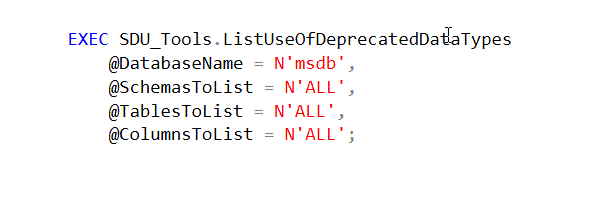
I’ve previously posted about the procedure ListUseOfDeprecatedDataTypes in our free SDU Tools for developers and DBAs. I mentioned that I’m often reviewing existing databases and one of the first things I go looking for is the way they’ve used data types, and that in particular, I’m keen to know if they’ve used any deprecated data types (i.e. ones that will/might be removed at some point).

The procedure was updated in version 21 to now include a ChangeScript column. (Thanks to Michael Miller for the suggestion).

2023-06-02

SDU Tools v23 is now available for download

SDU Tools v23 is now available for download

Just a heads-up that v23 of SDU Tools went out to SDU Insiders yesterday.

You can find details about SDU Tools here: https://sqldownunder.com/freestuff

In v23, we’ve added or enhanced the following:

  • ExcelSerialToDateTime - there’s so much corporate data stored in Excel, and if you need to import it to SQL Server, you quickly find that dates and times are a challenge. I have a friend who says that the only data types in Excel are numbers and strings, and that everything else is an illusion. I think that’s pretty accurate. This function takes one of the funky Excel decimal numbers (called a Serial) that represents a date and time, and converts it to a SQL Server datetime value.
  • DateTimeToExcelSerial - no prizes for guessing what this one does. It’s the opposite of the above.
  • We’ve done a lot of updates to internal data within the tools, like all up to date SQL Server build numbers, etc.
  • DateDimensionColumns now has StartOfWeek and EndOfWeek
  • DateDimensionPeriodColumns now has IsSameWeek, DayOffset, MonthOffset, and WeekOffset

You can see a short video on the new Excel conversion functions here: YouTube Video

2023-01-19

SDU Tools v22 is now available (finally)

SDU Tools v22 is now available (finally)

One of our popular free resources is the SDU Tools library. If you haven’t checked it out, I’d encourage you to do so. It’s a large library of functions, procedures, and views all written in native T-SQL code.

You can easily use it as a complete library, or use it as examples of how to write T-SQL code. v22 is now available for download.

If you aren’t on our notification list, you can add yourself here:

2022-06-05

SDU Tools: Weekday Across Years in SQL Server T-SQL

SDU Tools: Weekday Across Years in SQL Server T-SQL

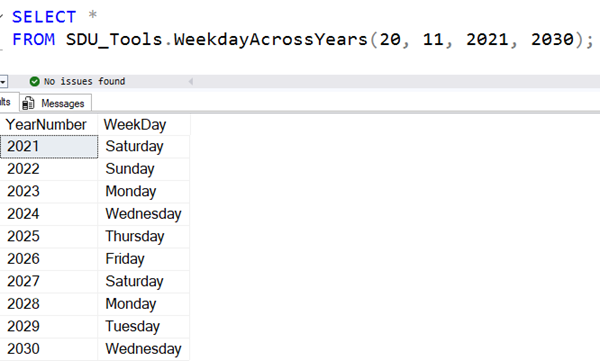
Another request that I received a while back, for a new function to our free SDU Tools for developers and DBAs, was to be able to find the day of the week, for the same day and month, over a range of years. A simple example would be to find what day Christmas will be each year for the next ten years. So we’ve added a new function WeekdayAcrossYears.

2021-04-23

SDU Tools version 21 is now released for download

SDU Tools version 21 is now released for download

Version 21 of our free SDU Tools for developers and DBAs is now released and winging their way out to our SDU Insiders.

You can find details on the tools here.

If you haven’t been using SDU Tools yet, I’d suggest downloading them and taking a look. At the very least, it can help when you’re trying to work out how to code something in T-SQL.

Along with the normal updates to SQL Server versions and builds, we’ve added the following new functions:

2021-04-14

SDU Tools: Weekday in same week using SQL Server T-SQL

SDU Tools: Weekday in same week using SQL Server T-SQL

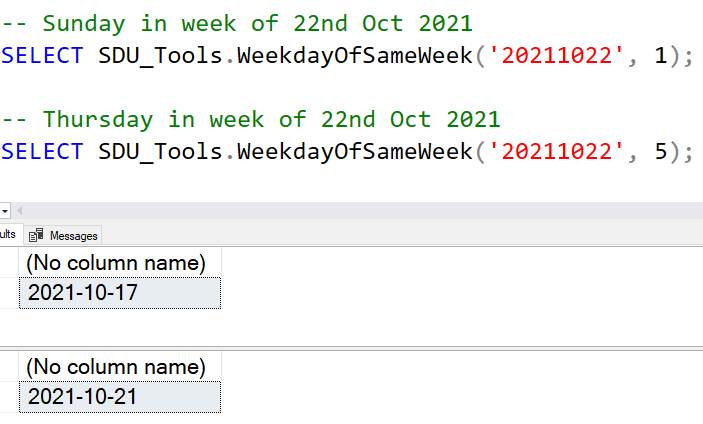
A while back, I got a request to add a new function to our free SDU Tools for developers and DBAs. The user wanted to be able to find a particular day of the week, in a given week. So for example, if I give you a date of 30th April 2021, what is the Thursday in that week? So we’ve added a new function WeekdayOfSameWeek.

It takes two parameters:

2021-02-19

SDU Tools: Date of Orthodox Easter in SQL Server T-SQL

SDU Tools: Date of Orthodox Easter in SQL Server T-SQL

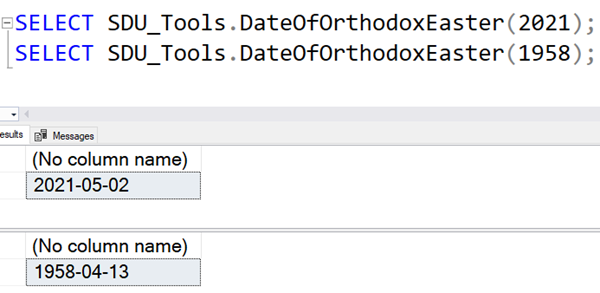
Some time back, we added DateOfEasterSunday to our free SDU Tools for developers and DBAs. Given it was the Christian Easter Sunday, almost immediately, I got a request for the Greek Orthodox Easter. That date isn’t of course just the Greek one, so we’ve added a new function DateOfOrthodoxEaster.

It’s based on a concept from Antonios Chatzipavlis. Thanks !

It takes a single parameter:

@Year int - the year to find the date for

2021-02-12

SDU Tools: Check if Lock Pages in Memory is Enabled on SQL Server

SDU Tools: Check if Lock Pages in Memory is Enabled on SQL Server

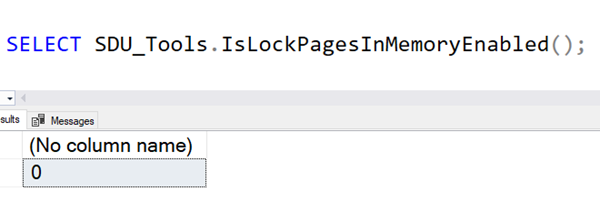
In our free SDU Tools for developers and DBAs, we have a lot of procedures and functions for checking system and database configuration details. One that we were asked for a function for, was the ability to check if the LockPagesInMemory (LPIM) setting was enabled, so we added that.

The function is called IsLockPagesInMemoryEnabled.

It takes no parameters, and returns a bit to indicate if the value is enabled or not.

2021-02-05

SDU Tools: COBOL-CASE in SQL Server T-SQL

SDU Tools: COBOL-CASE in SQL Server T-SQL

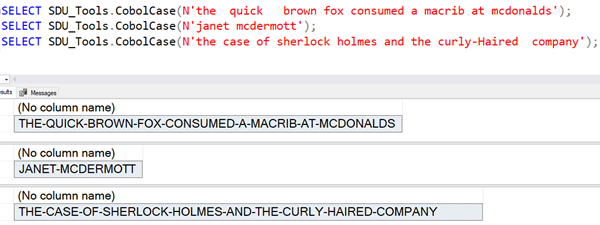
I’ve had a lot of good feedback about the options that we’ve provided in our free SDU Tools for developers and DBAs for formatting strings. Someone recently asked for a format with all capitals and dashes in between. I realised we didn’t have that, and we’ve added it. Generally, in the industry, this is referred to as Cobol Case.

So, we added a function CobolCase.

It takes one parameter:

2021-01-29