
Fabric RTI 101: Scaling Eventstreams
Scaling an Eventstream involves more than simply increasing capacity — it’s about ensuring that each stage of the data pipeline can handle higher volumes efficiently and reliably.
The first approach to scaling is by adding more inputs and outputs. As the number of data sources or destinations grows, Eventstream can be configured to handle multiple concurrent data feeds, such as several IoT hubs, Kafka topics, or application logs.
You can also tune the Eventstream’s capacity to handle greater throughput. This involves adjusting the compute and memory resources allocated to the Eventstream so that it can process more events per second without increasing latency.
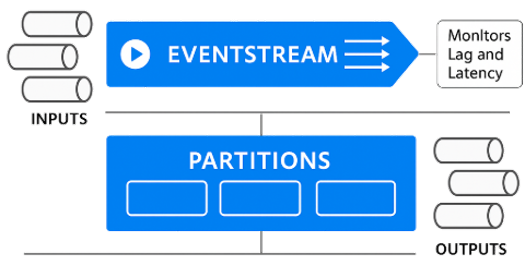
As the workload grows, it becomes essential to monitor both lag and latency. Lag shows how far behind consumers are in processing events, while latency measures the time it takes for data to flow from ingestion to consumption. Rising lag or latency typically indicates a bottleneck: for example, a slow consumer, inefficient queries, or inadequate partitioning.
For very large data volumes, partitioning becomes a key technique. By dividing a single event stream into multiple partitions — often based on a key such as customer ID, device ID, or region — you can enable parallel processing. This allows multiple consumers or compute nodes to process data independently, improving scalability and throughput.
Finally, it’s important to design for resilience. Avoid single points of failure by using redundant inputs, multiple processing nodes, and failover mechanisms. Scaling should improve not just performance, but also reliability.
Overall, effective scaling means balancing all parts of the pipeline (ingestion, processing, and output) so that no component becomes a limiting factor.
Learn more about Fabric RTI
If you really want to learn about RTI right now, we have an online on-demand course that you can enrol in, right now. You’ll find it at Mastering Microsoft Fabric Real-Time Intelligence
2026-09-08