Fabric RTI 101: Real-Time Sentiment Analysis Example

Monitoring brand reputation has become a continuous challenge in the age of social media. Platforms like X, Facebook, and Reddit can amplify sentiment rapidly, and a single negative trend can reach large audiences within minutes.
Problem to solve
Traditional sentiment analysis systems are often designed for batch processing — for example, analyzing posts every few hours or once per day. While this can capture overall trends, it fails to provide early warnings. By the time a report shows a spike in negative sentiment, the situation may already be public and difficult to control.
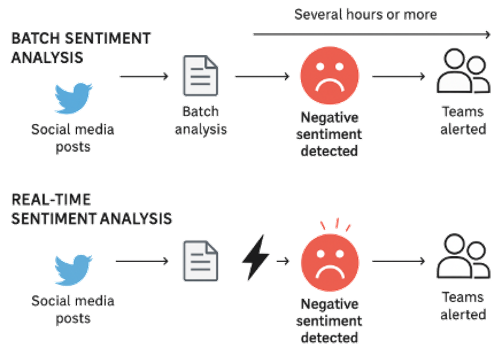
The business need is for real-time visibility into online discussions, allowing detection of sudden shifts toward negative sentiment as soon as they occur. This includes identifying keywords, hashtags, or influencers driving the change.
The goal is to alert communication or support teams early enough to intervene constructively — perhaps by posting a clarification, addressing complaints, or escalating genuine service issues before they gain momentum.
Real-time sentiment monitoring supports timely, data-driven decisions, helping organizations respond quickly rather than react after damage has already occurred.
Solution Architecture
This architecture demonstrates how streaming and analytical components can be combined to track sentiment in real time.
It begins with ingestion, where data from social media platforms or similar sources is streamed through systems such as Kafka or Azure Event Hubs. The Eventstream component receives this input, providing a consistent way to handle large volumes of short text messages as they arrive.
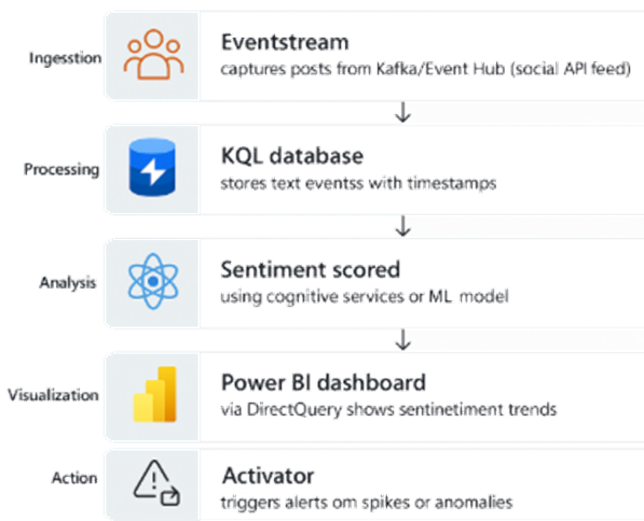
In the processing stage, each event — for example, a post or tweet — is stored in a KQL database along with its timestamp and relevant metadata such as author, platform, or topic. This structure allows time-based queries and makes it possible to detect changes in sentiment patterns over time.
The analysis step involves applying a sentiment model. This can be implemented using Azure Cognitive Services Text Analytics or a custom-trained machine learning model. Each message is assigned a sentiment score — typically positive, neutral, or negative — along with a confidence level. These scores form the basis for visual and analytical reporting.
For visualization, Power BI connects to the KQL database through DirectQuery, allowing dashboards to update as new data arrives. The dashboard might display real-time metrics such as overall sentiment distribution, negative sentiment trends, or top keywords associated with negative posts.
Finally, action is managed through Fabric’s Activator. It continuously monitors the sentiment scores or aggregated metrics and can trigger alerts or workflows when certain thresholds are exceeded — for instance, when negative sentiment rises sharply over a short period. These alerts might notify communication or support teams in Microsoft Teams or email, ensuring they can respond before a reputational issue grows.
Implementation Notes
The implementation focuses on connecting streaming data with analytical and alerting components in Fabric.
It begins with ingestion, where the social media feed — typically a continuous stream of posts, comments, or mentions — is connected through Kafka or Azure Event Hubs. These systems handle large volumes of messages efficiently and pass them into Fabric Eventstream for downstream processing.

In the KQL database, we use the extend operator to add a calculated field that contains the sentiment score for each message. This score usually comes from a machine learning model or a cognitive service API, which classifies text as positive, neutral, or negative.
Next, the data is aggregated into time windows using the summarize operator with bin() to group sentiment scores into short intervals, such as one to five minutes. This helps visualize overall sentiment trends and detect emerging patterns.
For anomaly detection, the KQL function series_decompose_anomalies can be applied to identify sudden shifts in sentiment levels. For example, a sharp increase in negative sentiment over a short period could indicate a developing issue or public concern.
Finally, Activator is configured to monitor these outputs. When thresholds are exceeded — for example, if the percentage of negative sentiment surpasses a defined limit — it can automatically send a Teams notification or email alert to the communications or support team. This allows for rapid investigation and response while discussion volumes are still manageable.
Learn more about Fabric RTI
If you really want to learn about RTI right now, we have an online on-demand course that you can enrol in, right now. You’ll find it at Mastering Microsoft Fabric Real-Time Intelligence
2026-09-02