
Fabric RTI 101: Building Digital Twins
The Digital Twin Builder in Microsoft Fabric Real-Time Intelligence is a design surface for representing real-world systems as manageable, structured entities inside Fabric.
A digital twin is essentially a logical model of something in the real world—such as a device, customer, room, vehicle, or any other object that produces events or has measurable state. The new builder allows you to define these entities directly within the Fabric experience without requiring a separate digital twin service.
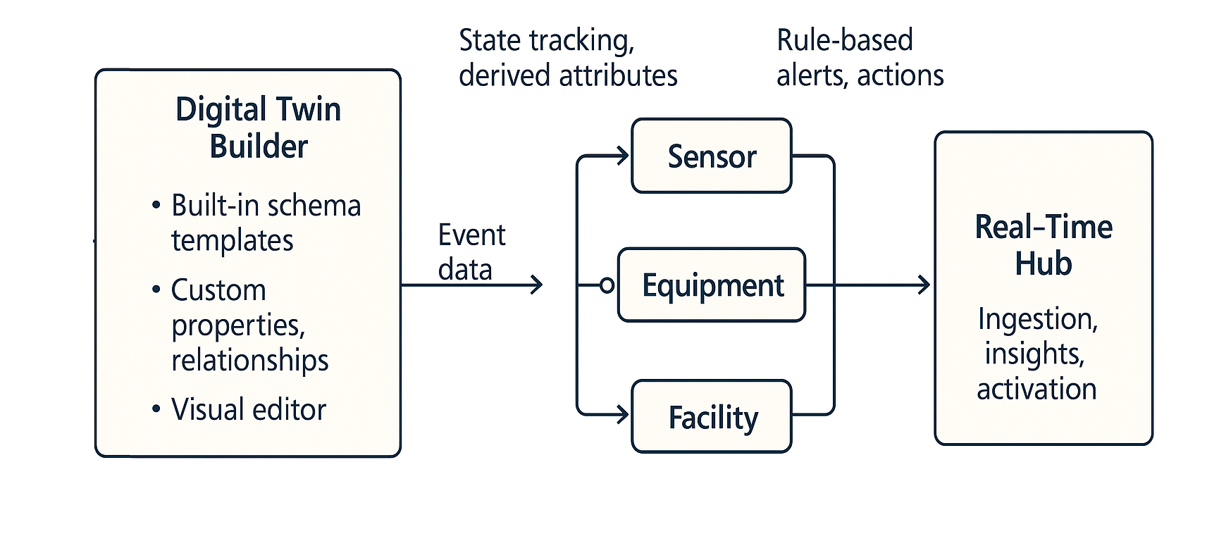
The first key idea is that the builder helps you formalize the shape of the entities you’re monitoring. You can create a twin type, define its properties, specify expected data types, and establish relationships between different types. For example, you might define a Vehicle type with properties like speed, fuel level, or location, and relate it to a Driver or Region type. The builder provides templates for common patterns, but these structures can be customised to match the domain the data belongs to.
Another important aspect is the automatic ingestion and updating of twin instances. When events arrive through an eventstream, they can be routed to twin definitions, updating the state of each instance as new data comes in.
This means you don’t have to build your own mapping layer between raw telemetry and a logical model—Fabric keeps the state of each twin current as events flow through the system. This includes support for derived properties, where you can calculate values based on existing attributes, and for stateful logic that tracks changes over time.
The builder also supports rules or actions. Once a twin is defined, you can attach conditions that trigger when certain patterns appear in the data. For instance, you might generate an alert when a sensor reading exceeds a threshold, or when the twin enters a specific state. These rules can integrate with Activator or other Real-Time Intelligence components so the twin becomes an active participant in your overall pipeline.
Integration with the Real-Time Hub is another key capability. Twin definitions, event sources, and actions operate together so that twins act as the conceptual centre point of processing. Instead of working with raw events, you work with named, typed entities that provide structure to real-time analytics and monitoring.
Finally, the visual editor is designed to make the modeling process easier. You don’t need to write code to define the structure, relationships, or actions associated with a twin. The builder supports iterative design: you can adjust definitions, test how data flows into the model, and evolve the structure as your scenario grows.
The Digital Twin Builder gives Real-Time Intelligence a higher-level abstraction for modelling the systems you’re tracking. It reduces the amount of custom code needed to maintain state, offers integration across Fabric’s real-time components, and provides a consistent way to reason about entities as they change over time.
Learn more about Fabric RTI
If you really want to learn about RTI right now, we have an online on-demand course that you can enrol in, right now. You’ll find it at Mastering Microsoft Fabric Real-Time Intelligence
2026-07-16