
Fabric RTI 101: Visual Exploration
When we work with real-time data in Fabric, not everyone wants to or needs to write KQL or SQL. That’s where visual queries come in.
They provide a no-code interface that lets you build streaming data queries using drag-and-drop actions instead of typing code.
You start with a data source — perhaps an eventstream, a table, or a KQL database — and then visually add steps like filters, joins, or aggregations. Each transformation appears as a node in a flow, so you can see exactly how the data changes from one step to the next. The design is similar to what you might have seen in Power Query or Dataflows, but it’s designed specifically for real-time and streaming data rather than batch processing.
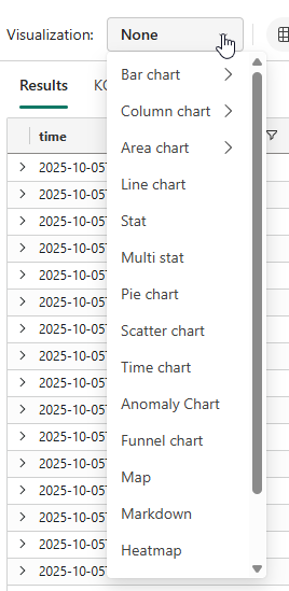
As you add each transformation, Fabric provides an instant preview of the data. That’s one of the most useful parts. It means you can check that your filters and joins are behaving as expected before the query ever runs continuously. It encourages a much more exploratory, iterative workflow — try a step, see the result, adjust, and move on.
Visual queries are particularly handy when you’re prototyping. Let’s say you’re preparing a real-time dashboard or trying to identify key metrics from a live event stream — you can sketch out your logic visually first. Once you’re happy with it, the same logic can be saved and later deployed as a full streaming job or transformed into a KQL statement behind the scenes.
This approach also lowers the barrier for people who aren’t fluent in query languages. A business analyst, for example, might understand what they want to see — such as filter to this sensor type, calculate the moving average, and group by location — but might not be confident writing the KQL to do it. Visual queries let them achieve that result independently, while still producing a robust and transparent definition that can be inspected or fine-tuned later by a developer.
Visual queries serve two main purposes: they make it easier for non-SQL or non-KQL users to work with real-time data, and they speed up experimentation for those who do know the languages but want a faster way to test transformations interactively. They bridge the gap between graphical tools and coded pipelines, which is especially valuable when teams are collaborating across different technical skill levels.
Learn more about Fabric RTI
If you really want to learn about RTI right now, we have an online on-demand course that you can enrol in, right now. You’ll find it at Mastering Microsoft Fabric Real-Time Intelligence
2026-05-11