
Fabric RTI 101: Applying Union
Another powerful transformation in real-time processing is the union. A union allows us to take multiple input event streams and merge them into a single, consolidated stream. This is especially useful when we have similar data sources that we want to treat consistently in downstream processing.
A common scenario is application logs. You might have several applications, each producing its own stream of log events. Instead of maintaining separate pipelines for each one, we can use a union to combine them all into a single log stream. From there, we can apply filters, mappings, or aggregations in a single place, which makes management much easier.
Another example is IoT telemetry. Imagine thousands of sensors across different buildings or regions. Each device might publish its own data stream, but downstream we don’t want to create thousands of separate pipelines. Instead, we unify them into one consolidated telemetry stream. That makes it much easier to calculate fleet-wide metrics like average temperature across all devices, or total energy usage across all sites.
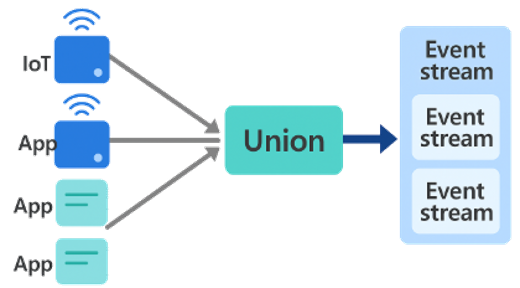
The union operation also helps with standardization. If each stream is mapped into a common schema first, the union merges them seamlessly, so downstream queries don’t need to know which source an event came from. They just see one coherent stream of events.
From an architectural perspective, unions reduce complexity and cost. Instead of duplicating processing logic across many parallel pipelines, we centralize it into one. That not only simplifies operations, but also ensures consistency — the same filters, mappings, and aggregations apply to all sources equally.
When you think of a union, think of it as a funnel: multiple parallel streams come in, and they’re merged into a single pipeline that can be processed efficiently and consistently.
Learn more about Fabric RTI
If you really want to learn about RTI right now, we have an online on-demand course that you can enrol in, right now. You’ll find it at Mastering Microsoft Fabric Real-Time Intelligence
2026-04-23