
Fabric RTI 101: How Fabric Connects to External Sources
One of the most powerful aspects of Fabric’s Real-Time Intelligence is how it connects to external sources. The mechanism for doing this is through Eventstreams. Eventstreams are essentially the pipelines that define where your data is coming in — the inputs — and where it’s going out — the outputs. In a later post, we’ll explore Eventstreams.
Fabric comes with a range of native connectors. These include direct connections to industry-standard technologies like Kafka, Azure Event Hubs, Azure IoT Hub, and other AMQP-based systems. That means if you already have investments in streaming infrastructure — whether in the cloud or on-premises — Fabric can plug into them without a lot of custom development.
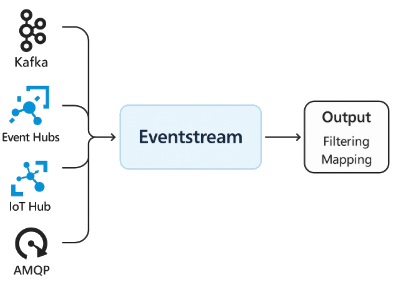
This flexibility is important because most organizations don’t have all their data in one place. Some events might be coming from cloud-native services, like Event Hubs in Azure. Others might still originate on-premises, perhaps from a Kafka cluster running in your own datacenter. Fabric supports both, giving you a consistent way to bring those events in.
Another key feature is that transformations can be applied right at ingestion. That means as the data flows into your Eventstream, you can do simple processing steps like filtering out noise, mapping fields into a standard schema, or even enriching the data with additional context. Doing this early simplifies downstream processing and ensures that what flows into your analytics pipelines is already in good shape.
The big value here is that Eventstreams provide a unified pipeline for all your real-time sources. Rather than managing ten different integrations separately, you manage them in one place — with consistent schema handling, monitoring, and governance built in. This unification not only simplifies operations, but it also ensures that real-time data flows into Fabric in a way that’s scalable and secure.
Eventstreams are the glue layer that connect external event sources into Fabric. They make ingestion simpler, transformations easier, and the overall architecture far more unified. And we’ll discuss more about them soon.
Learn more about Fabric RTI
If you really want to learn about RTI right now, we have an online on-demand course that you can enrol in, right now. You’ll find it at Mastering Microsoft Fabric Real-Time Intelligence
2026-02-26