
Book Review: The Practical Prompt Guide for GPT-6 Astra
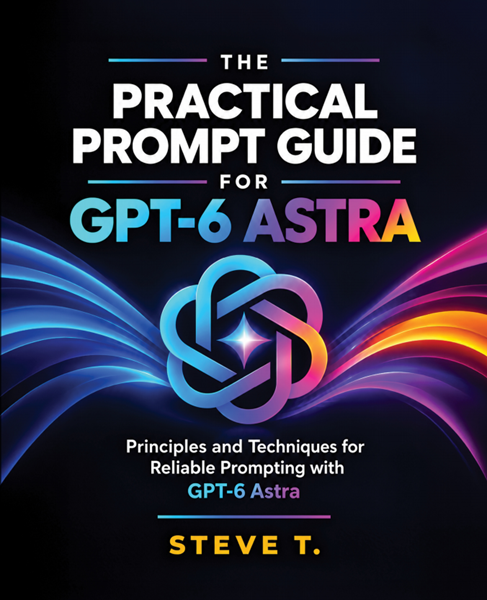
One of the interesting aspects of recent AI work is the idea that we’re fast moving beyond prompt engineering. Not that long ago, it was all the rage, so I was fascinated to receive a review copy of The Practical Prompt Guide for GPT-6 Astra from my friends at PacktT.
Author
Curiously, this book is listed as being written by Steve T. As noted on his official Leanpub biography page , the authors behind Steve Publications often choose to write under pseudonyms or partial names for privacy or professional reasons. Consequently, he only operates publicly under the name Steve. I’m not a fan of this as it limits his perceived authority.
What it does say is that Steve is a technology professional with more than 20 years of experience spanning software development, server infrastructure, cybersecurity, vulnerability research and reverse engineering.
The Practical Prompt Guide for GPT-6 Astra
The trouble with most books about prompting AI is that they treat the process as a collection of magic phrases. Add the right incantation, tell the model to act as an expert, insist that it makes its decisions step by step, and supposedly everything improves. This book takes a much more sensible approach. In the book, Steve argues that as AI models become more capable, we should spend less time trying to control every step and more time being clear about what we actually want. I can’t disagree with that.
The strongest ideas in the book focus on the distinction between a production brief and an instruction manual. Instead of telling Astra which file to read first, what to examine next, and precisely how to proceed, describe the outcome, establish boundaries, and let the model work out the details. That might sound obvious, but anyone who has watched prompts grow into enormous collections of defensive instructions will recognise the problem. Many of those instructions were added to work around weaknesses in older models. Keeping them indefinitely can make things worse rather than better.
I particularly liked the six-part prompt framework: Outcome, Source of Truth, Constraints, Authority, Output and Verification. It’s practical without being overly prescriptive. The inclusion of authority is especially important. Telling an AI what it may decide independently, and where it must stop for approval, is far more useful than a blanket instruction to ask permission before doing anything. Similarly, defining what finished means tackles a common frustration: an assistant that proposes a plan, does half the work, and then asks whether it should continue.
Systems like that tend to drive me crazy. I was doing some work with a Microsoft Rayfin app the other day, and it asked me for permissions so many times, that I ended up just being mesmerized and answering yes to everything anyway. The weird part is that it had options about not asking me every time, yet it seemed to ignore my response on that.
Useful discussions
The examples are generally where the book shines. There are useful discussions of ambiguity, conflicting instructions, excessive formatting, long-context work and the growing importance of reusable skills and AGENTS.md files. The software engineering chapters are probably the most relevant. I liked the argument that testing should be proportional to risk. A one-line fix shouldn’t automatically trigger an elaborate new test suite, while a change to authentication or a public API deserves much more scrutiny. That’s good engineering judgment, not just good prompting.
I also liked the attention paid to trade-offs. More autonomy may increase speed but reduce predictability. More context is not automatically better context. Higher reasoning effort has costs, and multiple agents are not necessarily better than one. The book also encourages testing prompts systematically rather than assuming that a longer or more sophisticated version must be an improvement. That emphasis on evaluation is one of its most durable lessons.
Limitations
However, I do have reservations. The book urges us to remove unnecessary instructions, but then ironically sometimes feels unnecessarily repetitive itself. The same advice about clarity, autonomy and trimming legacy prompts turns up in several chapters. Keep in mind that I was reading an early review copy and perhaps further editing might help with this. There were even passages repeated almost verbatim on the same page. A solid editorial pass would make the argument sharper and the book considerably more enjoyable to read.
I also think the book occasionally gets too close to treating model-specific behaviours as settled facts. Much of the technical discussion draws on OpenAI’s documentation, evaluations and published guidance. Those are useful starting points, but I’d have welcomed more independently demonstrated before-and-after results. Show me the same difficult task attempted with two prompt designs, explain the scoring, and let me see the difference. The book offers many examples of improved wording, but less empirical evidence of how consistently those changes improve outcomes.
Shelf Life
There’s also an unavoidable shelf-life problem. When I first heard about the book, that was my first reaction. Models change so frequently now. So, detailed discussions of pricing, reasoning settings, context limits and particular API features might seem valuable now, but this field moves extraordinarily quickly. I would have preferred to see some of that material in a reference appendix or a regularly updated companion resource, leaving more room for the principles that will survive the release of the next model.
Summary
Despite those criticisms, I think this is a worthwhile read, particularly for developers, technical professionals and experienced AI users who have accumulated increasingly messy prompts. It’s obviously not really a first introduction to AI, and I wouldn’t treat every recommendation as a universal rule. But its underlying message is excellent: stop trying to outsmart the model with elaborate prompting rituals. Define the job clearly, give it the right information, set sensible limits, and judge the result. That’s advice worth keeping, even when GPT-6 Astra becomes yesterday’s technology.
7 out of 10
2026-10-31