
Fabric RTI 101: KQL Materialized Views
In Kusto Query Language (KQL), materialized views are a key optimization feature that improve the performance of repeated or computationally expensive queries on streaming data. Normally, when you query a real-time data stream, the system must process the incoming events and apply all calculations each time the query runs. As data volumes increase, this can become inefficient and introduce latency.
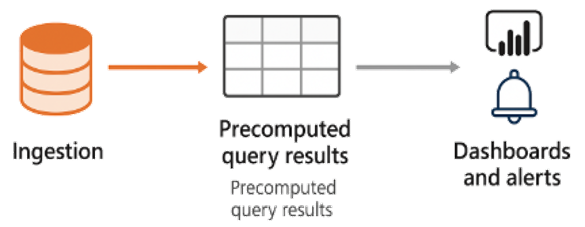
A materialized view solves this by precomputing and storing the results of a defined query in a physical table. This table is automatically updated as new events arrive.
The view behaves like a live summary of your data — always current, but much faster to query than recalculating from raw events.
Materialized views are particularly useful for aggregations or metrics that are used repeatedly, such as:
- Average temperature or response time per device
- Total transactions per hour or per region
- Counts or trends used in monitoring dashboards
Each time new events are ingested, the view is incrementally updated, meaning only the new data is processed. This incremental model keeps the resource cost low while maintaining freshness.
The two main benefits are:
- Lower latency — queries return results almost instantly because the heavy computation has already been performed.
- Reduced compute cost — since the same query doesn’t need to be reprocessed over large raw datasets.
In Fabric, materialized views are well-suited for real-time analytics and alerting scenarios, where fast access to aggregated results is critical. They’re often used to support Power BI dashboards or to feed Activator rules that depend on up-to-date metrics.
Learn more about Fabric RTI
If you really want to learn about RTI right now, we have an online on-demand course that you can enrol in, right now. You’ll find it at Mastering Microsoft Fabric Real-Time Intelligence
2026-09-10