
Fabric RTI 101: Cost Considerations for Streaming vs Batch
When designing real-time data systems, it’s important to consider the cost differences between streaming and batch workloads.
Streaming pipelines tend to be more expensive because they require always-on compute — data is constantly being ingested, transformed, and monitored, even during quieter periods. That means the compute capacity behind your Eventstreams, KQL queries, or Activator rules is active all the time.
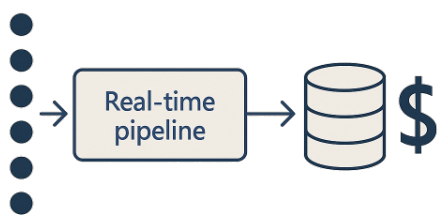
Batch processing, on the other hand, is usually cheaper and easier to control. It runs on a schedule — for example, hourly or nightly — so compute resources are only used when the job is running. This makes batch ideal for large volumes of data that don’t need to be processed instantly.
The best approach is often a hybrid pipeline:
Stream only the critical, time-sensitive data that supports real-time decisions. Handle non-urgent data in batch, where costs can be better managed.
Another key cost factor is data retention. Storing every raw event forever quickly becomes inefficient. Instead, persist only what you truly need — for example, aggregated summaries, key metrics, or events relevant to compliance requirements.
In Microsoft Fabric, you don’t directly manage storage tiers like hot or cold — that’s handled automatically by OneLake, which provides unified storage across your workspaces.
However, you can still manage data lifecycle effectively by moving older or less critical data to lower-cost environments, such as external Azure Data Lake or Blob Storage accounts, where tiered pricing (hot, cool, archive) can apply.
The overall principle remains the same:
- Use streaming where low latency is essential.
- Use batch where efficiency matters most.
Keep data lifecycle and retention policies in mind to control long-term storage costs. In short, cost optimization in Fabric comes from balancing compute use and data retention, rather than manually managing storage tiers.
Learn more about Fabric RTI
If you really want to learn about RTI right now, we have an online on-demand course that you can enrol in, right now. You’ll find it at Mastering Microsoft Fabric Real-Time Intelligence
2026-08-21