
Fabric RTI 101: KQL Databases
When we talk about KQL databases in Fabric, we’re referring to databases that are specifically optimized for high-volume, time-series, and log-style data. These databases are designed around the kinds of workloads that come from telemetry, sensors, applications, and services that continuously generate events.
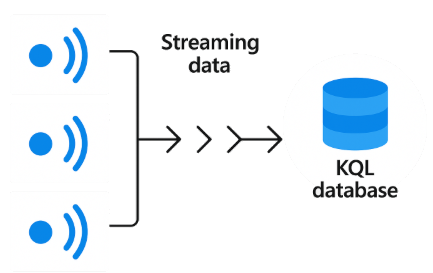
Rather than being general-purpose like a relational database, a KQL database is built to handle append-only, event-driven data at scale — often millions of rows per second. The architecture is different from what we see in traditional SQL databases. Data in a KQL database is typically stored in compressed, columnar form, which makes it extremely efficient to query across large time ranges or to aggregate over millions or billions of records.
The engine is optimized for fast scanning and filtering by time, which is a common access pattern in telemetry and monitoring scenarios. For example, when you’re looking at the last 15 minutes of log data from a service or trying to identify trends in sensor readings over the past day, the database can retrieve and summarize that data almost instantly.
A KQL database also supports a wide range of specialized analytical operators that are designed for real-time investigation. These include functions for time bucketing, joins across event streams, pattern and anomaly detection, and summarization over sliding or tumbling windows. This means you can easily build queries that look for outliers, correlate one event stream with another, or compute aggregates over moving time windows — all without having to preprocess or restructure the data elsewhere.
Because KQL databases are optimized for both speed and concurrency, they’re an excellent foundation for real-time dashboards and operational monitoring solutions. Dashboards built on top of these databases can update live, giving users an up-to-the-second view of what’s happening in their systems.
That’s why you’ll often see KQL databases used behind metrics dashboards, IoT telemetry views, or application performance monitoring solutions — anywhere you need to visualize data as it’s being generated.
It’s also worth noting that while KQL databases support very large volumes of incoming data, they’re not meant to replace traditional relational stores. You wouldn’t typically use one for transactional or highly normalized data. Their purpose is analytics on streaming and event data, where performance and responsiveness are the priorities.
KQL databases are purpose-built for time-series and event-driven workloads, offering very high ingestion and query performance, a schema model tuned for telemetry, and operators that make real-time analytics practical at scale. They’re one of the key components in Microsoft Fabric’s real-time intelligence architecture, and a core building block for most real-time analytical solutions in the platform.
Learn more about Fabric RTI
If you really want to learn about RTI right now, we have an online on-demand course that you can enrol in, right now. You’ll find it at Mastering Microsoft Fabric Real-Time Intelligence
2026-05-09