
Fabric RTI 101: Grouping
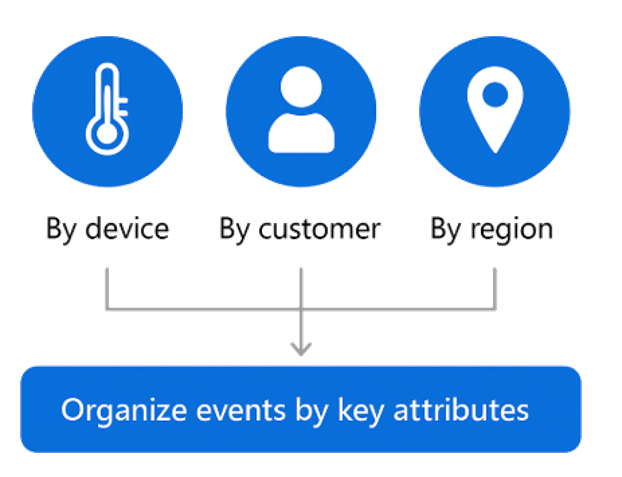
When we talk about grouping in real-time data processing, we’re talking about organizing events according to attributes that are meaningful for analysis. Instead of treating the event stream as one giant firehose, grouping lets us carve it up into categories that align with how the business thinks about its data.
For example, in an IoT scenario, we might group telemetry events by device ID. This way, instead of calculating one global average temperature across thousands of sensors, we can calculate average per device, giving us much more useful insights. In a retail scenario, we could group transactions by customer ID to analyze individual purchasing patterns, or by region to monitor performance across different locations. Grouping is what enables those per-customer, per-device, or per-region dashboards that managers and operators rely on.
Grouping also acts as the foundation for aggregation. Once we’ve organized events into groups, we can apply aggregation functions — like count, sum, or average — within each group. For instance, we might calculate ’total sales per customer per hour,’ or ‘maximum vibration reading per machine in the last 5 minutes.’ Without grouping, those kinds of breakdowns wouldn’t be possible.
Another key aspect is scalability. When streams are grouped, they can also be partitioned. This means different processors can handle different groups in parallel — one node might handle customer IDs starting with A–M, while another handles N–Z. That parallelism is essential for handling very high event volumes in real time. If we tried to process everything in one monolithic stream, the system would quickly become overloaded.
So grouping really gives us two big advantages: it makes analytics more relevant and precise by breaking data down into meaningful categories, and it makes pipelines more scalable and efficient by enabling parallel processing.
When you design real-time pipelines in Fabric, think carefully about the grouping keys you choose. They need to line up with how the business wants to slice its data, but they also need to be practical for performance and scale.
Learn more about Fabric RTI
If you really want to learn about RTI right now, we have an online on-demand course that you can enrol in, right now. You’ll find it at Mastering Microsoft Fabric Real-Time Intelligence
2026-04-09