
Fabric RTI 101: Mapping Events
Another key part of event processing in Fabric is mapping. Mapping is all about shaping the raw events into the structure you actually want to work with downstream.
When data first arrives, it often comes in the schema defined by the producer system. That might not match what your analytics tools, your warehouse, or your business users expect. For example, a device might send a field called ’tempC’ when you really want it named ‘TemperatureCelsius’.
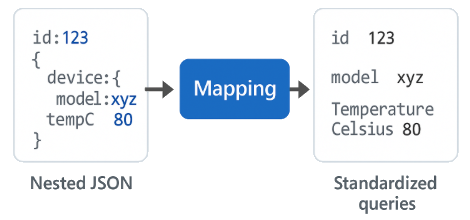
With mapping, you can rename fields as they flow in, so you’re not stuck with inconsistent naming conventions across sources.
You can also adjust data types during mapping. Perhaps one system sends a field as text, but you really need it as an integer or a datetime for analytics. Fixing that at ingestion means fewer headaches later, and it avoids cluttering queries with endless type conversion functions.
One of the most powerful uses of mapping is handling nested JSON structures. Many modern systems, especially IoT devices and web applications, send deeply nested JSON payloads. While that’s great for machines, it’s not very friendly for analytics. Mapping lets you flatten those structures into usable columns, making the data far easier to query in SQL or KQL.
The real value of mapping shows up when you’re dealing with multiple sources. Each one might have its own schema quirks, different field names, or slightly different structures. Without mapping, combining those streams can be messy and inconsistent. With mapping, you can standardize them into a single consistent schema, so downstream queries and dashboards don’t need to care where the data came from.
Mapping makes downstream queries simpler, faster, and more reliable. Instead of every analyst or developer dealing with messy source formats, you do the cleanup once at ingestion. From then on, everyone works with data that’s well-structured and standardized across the board.
Mapping is a translation step — it takes events in whatever dialect they arrive in, and converts them into a consistent, analytics-ready language for the rest of your system.
Learn more about Fabric RTI
If you really want to learn about RTI right now, we have an online on-demand course that you can enrol in, right now. You’ll find it at Mastering Microsoft Fabric Real-Time Intelligence
2026-03-20