
Fabric RTI 101: Event Processing Inputs
When we look at event processing inputs, the first thing to know is that Fabric supports a broad range of streaming sources. The big four are Kafka, Azure Event Hubs, Azure IoT Hub, and any system that speaks AMQP. These cover most of the event-driven architectures you’ll see in the real world, from enterprise message brokers to IoT device fleets and large-scale cloud-native streaming pipelines.
Another important point is that inputs can come from both cloud and on-premises environments. Many organizations are in hybrid mode — perhaps you’ve got a Kafka cluster still running in your datacenter, while also using Event Hubs in Azure for new workloads. Fabric Eventstreams can connect to both, allowing you to bring all those events into a unified pipeline without needing to modernize everything at once.
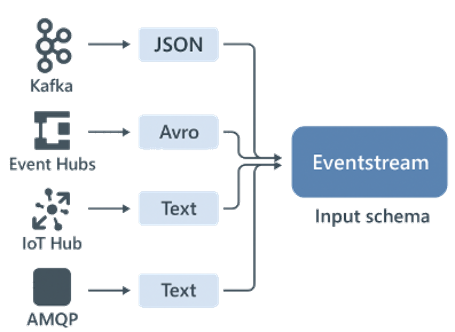
One of the strengths of Eventstreams is that you can define multiple inputs feeding into a single stream. So you’re not limited to just one source at a time. You might combine IoT telemetry, application logs, and transactional events into a single pipeline, applying consistent transformations before sending them downstream. That consolidation is very powerful, because it means you don’t need separate infrastructure or tooling for each source.
When those events arrive, they won’t all look the same. Input schemas can vary: some systems send JSON, others Avro, and some even plain text logs. Eventstreams don’t force one standard upfront — instead, you define the schema as part of the input configuration. That schema definition is what allows Fabric to parse, validate, and process the events consistently. Without it, downstream queries and transformations wouldn’t know how to interpret the data.
The key step in configuring an input is setting up both the connection details — where the data is coming from and how to authenticate — and the schema definition, which tells Fabric what the data looks like. Once that’s done, the pipeline can treat events uniformly, regardless of their original format or source.
Eventstreams give you the flexibility to pull from a variety of input sources, whether cloud or on-premises, structured or semi-structured. Multiple inputs can merge into a single flow, and schema definition ensures that even diverse formats are handled consistently.
Learn more about Fabric RTI
If you really want to learn about RTI right now, we have an online on-demand course that you can enrol in, right now. You’ll find it at Mastering Microsoft Fabric Real-Time Intelligence
2026-03-14