
Book Review: When No One's Keeping Score
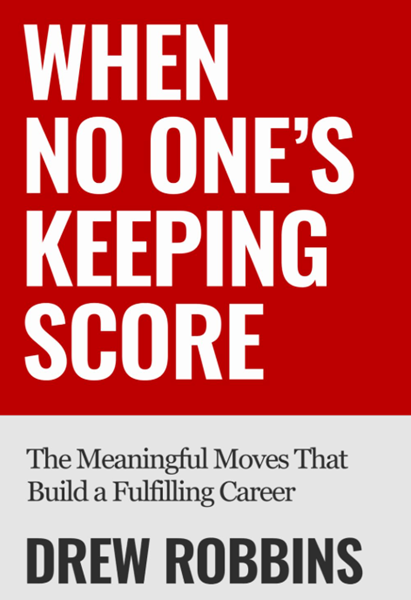
I’m hoping to have Drew Robbins on my new Tech Career for Life Podcast later this week, and I noticed that he had a new book out, so I decided I’d read it before I had him on the show.
In a working world obsessed with metrics — titles, promotions, performance reviews When No One’s Keeping Score lands with a quiet but deliberate challenge: what if the work that matters most is the work that never shows up on a scoreboard?
Drew’s book is not a manifesto against ambition, nor is it another productivity system disguised as career wisdom. Instead, it is a reflective, experience-driven guide to building a career with depth, resilience, and meaning — particularly at a time when technology and AI are reshaping what work even looks like.
Who This Book Is For ?
Drew writes for people who sense that something is missing from the conventional career playbook. Early-career professionals unsure how to orient themselves, mid-career leaders questioning what progress really means, and experienced practitioners navigating change will all find familiar tensions here. His background—more than two decades of leadership across the U.S., Japan, and India, including long experience at Microsoft — gives the book credibility without turning it into corporate folklore.
What stands out is that the book does not assume a single industry, role, or personality type. While many examples come from technical and corporate environments, the lessons are framed broadly enough to apply anywhere people work together.
The Core Idea: Meaning Over Metrics
At the heart of the book is a simple but uncomfortable observation: the traditional ways we keep score at work are breaking down. Promotions slow or disappear, job ladders flatten, and external validation becomes unreliable. He argues that anchoring your sense of worth to these signals is not just fragile — it is actively harmful.
Rather than offering a replacement scoreboard, the book reframes career progress as a series of Meaningful Moves: small, intentional choices that compound over time. These moves are not about visibility or status; they are about presence, relationships, growth, leadership, and focus.
The Five Meaningful Moves
The structure of the book revolves around five principles that Drew returns to repeatedly, each illustrated through stories rather than abstractions.
Be Present focuses on attention as a scarce and undervalued skill. He describes environments where distraction is normalized — even in high-stakes meetings — and contrasts that with the impact of fully engaging with people and problems in front of you.
Invest in Relationships emphasizes building trust horizontally, vertically, and outward across an organization. The book consistently treats relationships not as networking tactics, but as long-term systems of mutual support and learning.
Grow with Purpose distinguishes between productive discomfort and genuinely toxic situations. Stretch assignments, feedback, and unfamiliar roles are framed as necessary inputs to growth, but only when they serve learning rather than erosion.
Take the Lead reframes leadership as influence rather than authority. Drew’s cross-cultural experiences are particularly effective here, showing how leadership looks different in different contexts, yet still rests on initiative and responsibility. Having worked in Chinese banks in Asia, I had a bit of a chuckle when I read about some of his experiences.
Choose What Matters addresses busyness directly. With automation and AI removing more low-value tasks, Drew argues that the real question is not how to do more, but what not to do — so time and energy can be redirected toward thinking, creativity, and human connection.
AI, Technology, and the Human Edge
One of the more timely aspects of the book is how it looks at these ideas in the context of generative AI. He does not frame AI as a threat to be feared or a tool to be worshipped. Instead, he treats it as a forcing function that exposes what humans uniquely contribute: empathy, judgment, creativity, and the ability to navigate ambiguity.
This theme is reinforced in discussion drawn from a podcast conversation, where Drew argues that as AI absorbs routine tasks, the value of human skills becomes clearer, not weaker. Careers, in this view, are strengthened by doubling down on what technology cannot replicate.
What Others are Saying
I read some other customer reviews for this book and they echo a consistent response: the book feels grounded. Readers highlight the honesty of the stories, the absence of hype, and the emphasis on collaboration over competition. Some note that parts of the book resonate most strongly with technical or Microsoft-adjacent audiences, but even those reviewers acknowledge that the underlying lessons translate well beyond that context.
The repeated comparison to a trusted mentor is telling. This is not a book that promises transformation in thirty days; it is one that encourages reflection and deliberate adjustment over time.
Final Thoughts
When No One’s Keeping Score succeeds because it resists easy answers. It does not replace one set of career metrics with another, nor does it pretend that uncertainty can be eliminated. Instead, it offers a way to orient yourself when external signals are noisy or absent altogether.
If you are looking for tactical advice on optimizing promotions or negotiating compensation, this is not that book. But if you are interested in building a career that holds together through change — technological, organizational, or personal — Drew offers a thoughtful and practical framework worth spending time with.
In a world increasingly fixated on measurement, this book makes a quiet case for paying attention to what endures when no one is keeping score.
Summary
Overall, I liked this book. But what made it extra-interesting for me, is that Drew referenced many people that I know personally from his days at Microsoft.
8 out of 10
2026-02-10