
Fabric RTI 101: Message Brokers and Event Streams
Let’s talk about message brokers and event streams — these are the backbone technologies that make real-time systems work at scale.
At the simplest level, a message broker acts as a middleman between the systems producing events and the systems consuming them. Instead of producers and consumers being tightly coupled — where the producer has to know exactly where to send data and the consumer has to be available at the exact right moment — the broker sits in between and handles that communication.
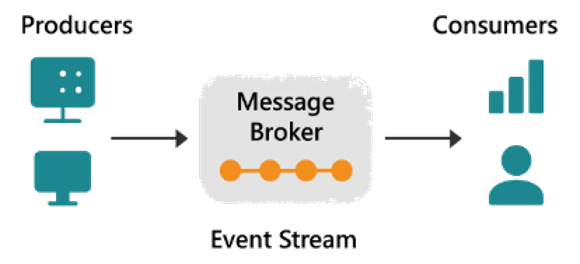
This decoupling is powerful because it means producers and consumers can operate independently. Producers can generate events at whatever rate they need, and consumers can pick them up when they’re ready. The broker makes sure the messages are stored temporarily, routed correctly, and delivered reliably, even if consumers are a little behind.
When those events are flowing through a broker, they’re typically organized into streams. A stream is just an ordered sequence of events — one after another — that consumers can subscribe to. The ordering is important because it preserves the timeline of what actually happened. Even if you have dozens of consumers, they’re all working from the same ordered event log.
This architecture also enables scalability. Multiple consumers can subscribe to the same stream — maybe one team is analyzing data for anomalies, another is archiving it, and another is powering a dashboard — all without interfering with each other. The publish/subscribe model makes this really flexible and efficient.
Examples of these technologies include Kafka, RabbitMQ, and Azure Event Hubs. Each has its own strengths and ecosystem, but the principle is the same: a broker in the middle, streams of ordered events, and consumers subscribing to the streams they care about.
I was thinking of the analogy of a message broker like a post office. The producers are the people dropping letters into the mailbox, the broker is the post office that sorts and organizes those letters, and the consumers are the people who come and collect their mail. The senders don’t need to know exactly where the recipients live or whether they’re home right now — the post office handles all of that. The stream is like the mail delivery route, keeping everything in the right order and making sure nothing gets lost.
The irony of this familiar analogy is that post offices delivering letters is fast becoming a thing of the past. I saw the other day that Denmark is no longer delivering letters. They’ll deliver parcels but not letters.
Regardless, message brokers and event streams provide reliability, scalability, and flexibility — and they’re a critical foundation for building real-time pipelines in Fabric.
Learn more about Fabric RTI
If you really want to learn about RTI right now, we have an online on-demand course that you can enrol in, right now. You’ll find it at Mastering Microsoft Fabric Real-Time Intelligence
2026-02-02