
Fabric RTI 101: What are Streams?
Once we understand what an event is, the next concept is the stream. A stream is simply a continuous flow of events over time. Instead of looking at events one by one in isolation, a stream is what you get when you treat them as a live feed coming from a source.
For example, imagine an IoT scenario. Each sensor reading from a device is an event. But when you look at all those readings flowing in second by second, that becomes a stream of telemetry. In a financial system, every transaction is an event — but all transactions flowing in from your payment gateway form a transaction stream.
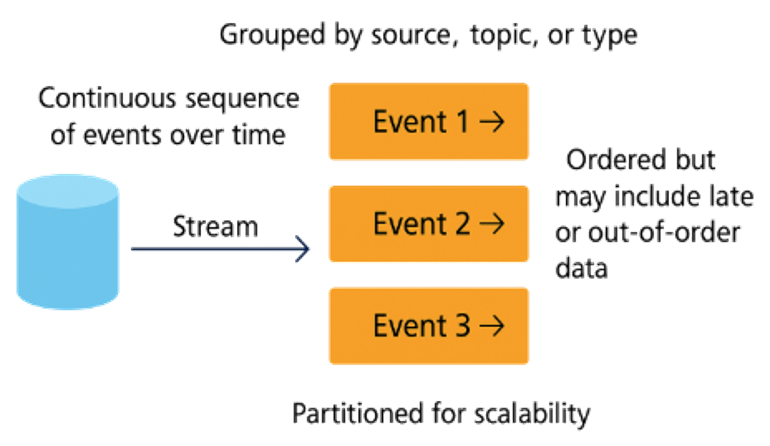
Streams are usually grouped by a source, topic, or type of event. You might have one stream for website click events, another for purchase events, and another for error logs. This grouping makes it easier to organize and process data because consumers can subscribe to the specific streams that are relevant to them.
Because event volumes can be massive, streams are often partitioned for scalability. Partitioning means the data is split into parallel lanes so multiple consumers can process the stream simultaneously. This ensures you can keep up with high-throughput scenarios without overloading a single processor. For instance, a stream of millions of IoT readings per second might be divided across dozens of partitions so each node processes a subset.
Now, an important point: streams are ordered, but that order isn’t always perfect. Ideally, events arrive in the exact sequence they were generated. But in practice, networks are messy. Sometimes events arrive late or out of order. For example, if a mobile device temporarily loses connectivity, its events may show up minutes later, and out of sync with newer events. Real-time systems have to be designed to handle that complexity — you can’t always assume everything arrives in perfect sequence.
Streams form the foundation of real-time analytics pipelines. They are the raw, continuous inputs that you build on. Whether you’re filtering, aggregating, joining, or triggering actions, it all starts with consuming data streams. Without streams, you don’t have the substrate for real-time intelligence.
Think of streams as the pipes carrying an endless flow of events. They’re grouped, scalable, and ordered — but they also introduce challenges like late arrivals. And they’re the starting point for everything else we’ll do in a real-time system.
Learn more about Fabric RTI
If you really want to learn about RTI right now, we have an online on-demand course that you can enrol in, right now. You’ll find it at Mastering Microsoft Fabric Real-Time Intelligence
2026-01-21