
Book Review: Introduction to .NET Aspire
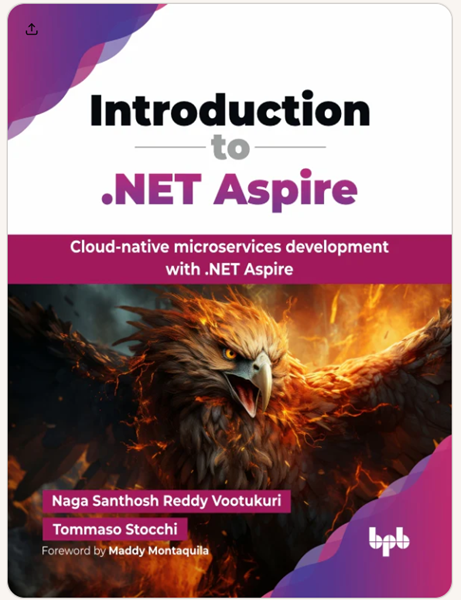
I recently received a review copy of Introduction to .NET Aspire: Mastering Cloud-Native Microservices Development with .NET Aspire by Naga Santhosh Reddy Vootukuri and Tommaso Stocchi from my friends at BPB Publications.
Authors
Naga Santhosh Reddy Vootukuri works for Microsoft as a Principal Software Engineering Manager in the Azure SQL product. He has deep knowledge in cloud computing, distributed systems,AI, microservice-based architecture, and cloud-native apps. Santhosh has authored and published numerous research articles in peer-reviewed and indexed journals and in major trade publications. He is a core MVB blogger at DZone and an active senior IEEE member handling various conferences as technical chair in the Seattle IEEE region. Naga has been awarded the prestigious Docker Captain membership program for his outstanding contributions to the Docker and containers community.
Tomasso Stocchi is a Cloud Solution Architect for Microsoft’s Application Innovation team. He helps developers leverage Microsoft’s technologies to build cloud-native intelligent applications and implement DevOps practices. He has extensive experience and knowledge in cloud computing and software development.
Name change
One of the first things I’d comment on with this book is that .NET Aspire is now just Aspire. It’s so frustrating when Microsoft changes the names of products late in the release cycle. This one changed names at the point of GA (General Availability). That means there’s a lot of editing of the name needed throughout this book, as the name .NET Aspire appears in so many places. Nothing else really needs to change. The microservices-related content is still totally relevant.
I share the frustration with this. I had been building an online course with Microsoft Fabric Real Time Intelligence recently, only to find that the Data Activator became just the Activator at release. Given how much many people have worked with these sorts of products before release, and how much content is already available, these types of changes are annoying.
Content
Over recent times, I’ve been hearing a lot about Aspire but I hadn’t had a good chance to try it out. So, getting to review this book was very timely for me.
Aspire is an interesting new set of technologies from Microsoft. One key change is that, like languages such as Ruby, it looks to use convention over configuration where it can. This can simplify applications.
The primary target for Aspire is as a cloud-ready stack for building observable, production-ready distributed applications, simplifying local development and deployment.
The book stars by describing the challenges of distributed application development and discusses how Aspire fits into this, by presenting a sample architecture for the application that’s built throughout the book.
Next, the book covers integrations with databases and other external services. It spends some time covering the Data API Builder (DAB) that has become popular in recent years.
The third chapter is interesting. It shows how you can take advantage of the unique offerings of different languages when building distributed systems. Each service can be written using the most appropriate language. While I can see the argument for that, I do worry about the practicality of doing that in real world teams. Just look at how hard it is to get developers to learn about T-SQL, even though they spend their whole lives working with data.
Chapter 4 dives into monitoring. This is another area where Aspire shines. Even when you start with a really basic startup template, services like monitoring are already in place, and linked to from the supplied dashboard. I like that because it removes the arguments about how to do this when people are building applications with it. It’s another area where convention will win out. Pleasingly, this is based on the OpenTelemetry model which has already been widely adopted.
Chapter 5 gets into deployment strategies, and in particular, the use of Azd (the Azure Developer CLI) and Chapter 6 follows up by covering DAPR integration. DAPR is another technology that I’m seeing widely deployed today. Chapter 7 shows how Aspire provides orchestration for end-to-end unit testing.
And it would’t be a technical book today, if there wasn’t a chapter on AI integration. That’s what you’ll find in the final chapter.
Thoughts on the book
The authors are able to provide insights and background information in this book, that are only available from people within Microsoft. An example is the explanation of how Aspire grew out of Project Tye.
Summary
Overall, I liked this book. It took me from the having heard about Aspire stage to the having an idea how to use and apply Aspire stage. And that’s what I needed.
7 out of 10
2025-12-12