
Posts

Shortcut: Creating T-SQL Templates in SQL Server Management Studio (SSMS)

Shortcut: Creating T-SQL Templates in SQL Server Management Studio (SSMS)

A few weeks back, I mentioned how useful templates can be. I said that I’d discuss how to create them later. Well that’s today.

I thought I’d take dropping a database as an example. The supplied template doesn’t work for me, so let’s create a new one.

Note: SQL Server 2016 SP1 introduced DROP DATABASE IF EXISTS but I find that option quite useless. It fails if anyone is connected to the database. And to disconnect people beforehand, you need to first check if it exists, so the statement is pointless.

2018-01-04

SDU Tools: Determining Leap Years in T-SQL with IsLeapYear

SDU Tools: Determining Leap Years in T-SQL with IsLeapYear

Is 2018 be a leap year?

Was 2000 a leap year?

Will 2100 be a leap year?

When I was a young student at school, we learned that leap years were every four years. Then as I got older, I learned that there was more to it than that.

It’s important to understand that any calendar is just an approximation, and there is a lot more to calendars than most people realize.

2018-01-03

SQL: Auto Page Repair in SQL Server ? (Or Not?)

SQL: Auto Page Repair in SQL Server ? (Or Not?)

Database mirroring was added in SQL Server 2005. One of the features added to it in SQL Server 2008 was auto page repair. When SQL Server 2012 was released, Availability Groups also offered auto page repair.

Just how useful is this feature though?

I’ll start by saying that it can’t hurt.

When SQL Server is reading a page on the primary replica and receives an unrecoverable I/O error (typically but not always, an error 823 for a checksum error), it will try to repair the page when:

2018-01-02

Opinion: If you can't type, you are writing worse code than if you could

Opinion: If you can't type, you are writing worse code than if you could

Let me make a potentially bold statement:

People who can’t type write worse code than they could be writing

I’m sure that will upset some people (probably those who can’t type or who are two or four finger typists) but it’s a conclusion that I’ve come to over many years. Coding is clearly not the same thing as typing but the reason is simple:

To write good code, you need to be prepared to constantly refactor and rework the code that you write, and if you can’t do that quickly, you’ll be more reluctant to do it.

2018-01-01

SDU Tools: Converting T-SQL Strings to Snake Case and Kebab Case

SDU Tools: Converting T-SQL Strings to Snake Case and Kebab Case

In a recent blog post, I described converting strings to Proper Case and Title Case. And more recently, I described how to convert them to Pascal Case and Camel Case.

The final option (for now) in this set is conversion to Snake Case and Kebab Case.

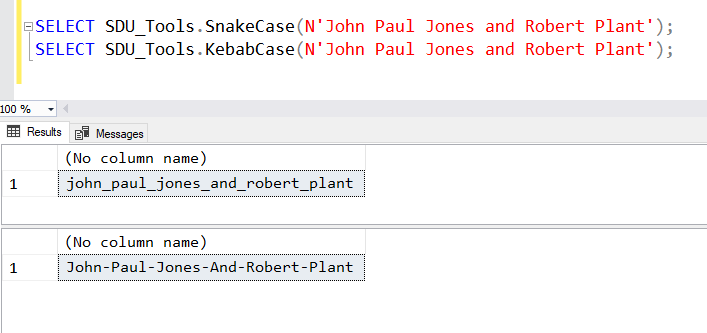
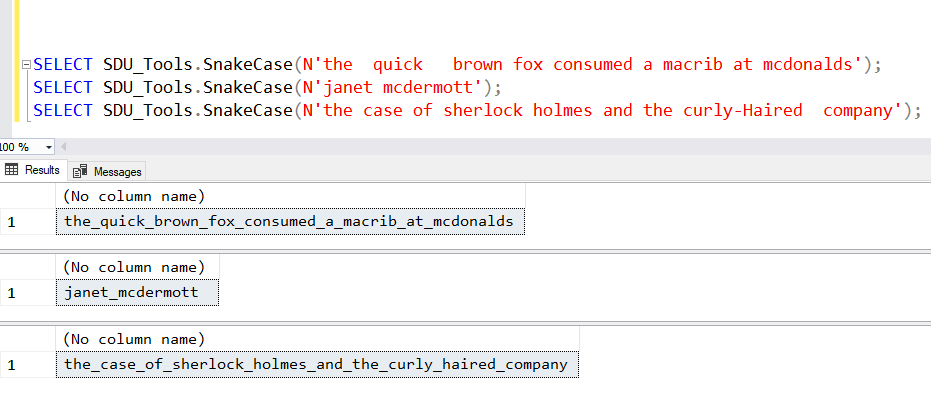
In Snake Case, all words are lower-cased, then all spaces between words are replaced by underscores.

You can see it in this example:

2017-12-29

Shortcut: Using Colors to Avoid Running Scripts Against the Wrong Server

Shortcut: Using Colors to Avoid Running Scripts Against the Wrong Server

Everyone who’s worked with SQL Server for any length of time, has had the experience of executing a T-SQL script, and then noticing, with horror, that they’ve just executed the script against the wrong server.

You know the feeling. It even happens at Christmas time, just when you were hoping to get away from work for a few days, or when you are the unlucky one who’s doing on call work.

2017-12-28

SDU Tools: Show SQL Server Backup Completion Estimates

SDU Tools: Show SQL Server Backup Completion Estimates

When you first start working with SQL Server, you’re often working with smaller databases and every backup seems to happen quickly. SQL Server is fast at creating backups.

When you get to larger databases, backups start to take a while. Fortunately, backup is one of the commands that sets a percentage complete value that can be seen in the sys.dm_exec_requests system view.

And when the databases get even larger, the question quickly becomes:

2017-12-27

Opinion: And One Column to Rule Them All

Opinion: And One Column to Rule Them All

I work with a lot of SQL Server databases that are poorly normalized. One of my pet dislikes is the column to rule them all.

Here are simple tests:

If I ask you what’s stored in a column and you can’t tell me a single answer , then you’ve got a problem.

If you need to refer to another column to work out what’s in the first column, then you’ve got a problem.

2017-12-26

SDU Tools: LeftPad and RightPad in T-SQL (Right-align, Left-align)

SDU Tools: LeftPad and RightPad in T-SQL (Right-align, Left-align)

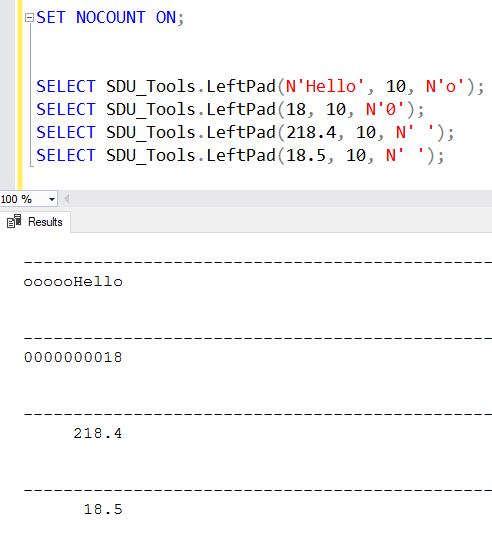
Over the years, I’ve had a surprising number of questions on how to right-align a set of numbers using T-SQL.

The first concept that people seem to miss is that numbers aren’t strings. So there’s no concept of actually aligning a number, it’s only a string representation of a number that can be right-aligned or left-aligned. Or how it’s displayed in a client application.

But if you really want to create a string that has right-aligned numbers, then left padding of the number is what you want.

2017-12-22

Shortcut: Using a Count with the GO Batch Separator in T-SQL

Shortcut: Using a Count with the GO Batch Separator in T-SQL

In T-SQL, a script is a set of one or more batches.

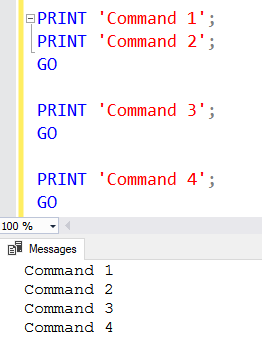
For example, if we have the following script and click Execute, it looks like all the commands were sent to the server and executed all at once:

But that isn’t what happened.

What did happen is that SQL Server Management Studio (SSMS) found the word GO and broke the script into a series of batches. In this case, there were three batches. First, it sent the commands shown here as Batch 1 to the server, waited for them to execute, then sent Batch 2, waited for it to execute, then sent Batch 3, and waited for it to execute.

2017-12-21