
Fabric RTI 101: Designing Eventstream Pipelines
When it comes to designing an Eventstream pipeline in Fabric, the process generally follows a clear, three-step flow. First, you start with the inputs — the data sources. This might include Kafka, Event Hubs, IoT Hub, or other streaming systems. At this stage, you define the connections and schemas so Fabric knows how to interpret incoming events.
The second step is where you apply transformations. These are the operations that make raw data more usable and more valuable. You might apply filtering to reduce noise and drop irrelevant events. You might use mapping to rename fields, adjust types, or flatten JSON into something cleaner. And you might use routing to branch different types of events to different destinations. Together, these transformations ensure that events are shaped, cleaned, and directed properly before they move downstream.
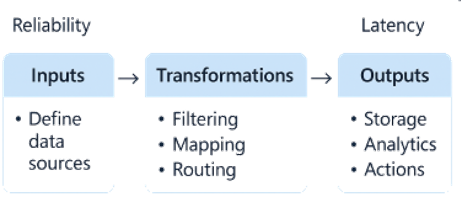
The third step is defining the outputs. This is where you decide how events will be consumed. Some outputs may be storage-focused, like Lakehouses or Warehouses, for long-term persistence and analytics. Others may be analytics-focused, like KQL Databases for fast queries. And some may be action-oriented, such as real-time dashboards in Power BI or automation through Activator. A single Eventstream can support multiple outputs, so you’re not limited to just one path.
Alongside those functional steps, you also need to think about non-functional requirements:
- Reliability — What happens if a source goes down, or a destination is temporarily unavailable? Your pipeline design should account for retries, ordering, and durability.
- Latency — Not every use case needs sub-second response times. Be clear on how quickly the business needs to react, and balance speed against cost and complexity.
- Scalability — Can the pipeline handle sudden spikes in volume, like end-of-month reporting or seasonal surges in transactions?
Finally, the pipeline design must align with business requirements. Not every event is worth storing forever, and not every metric needs to be analyzed in real time. The right design keeps costs under control, avoids over-engineering, and ensures the business gets insights where they matter most.
When you’re designing an Eventstream pipeline, think of it as inputs → transformations → outputs, wrapped in a set of decisions around reliability, latency, scalability, and business value. That mindset leads to pipelines that are both technically sound and business-aligned.
Learn more about Fabric RTI
If you really want to learn about RTI right now, we have an online on-demand course that you can enrol in, right now. You’ll find it at Mastering Microsoft Fabric Real-Time Intelligence
2026-05-05