
Fabric RTI 101: Ingestion Modes
When we talk about ingestion modes in Fabric Real-Time Intelligence, we’re really thinking about how events move from their source into a destination, such as an Eventhouse table or another downstream system.
The pattern you choose affects latency, cost, data quality, and the flexibility of your real-time architecture. There are two broad models that students will encounter: direct ingestion and processing before ingestion.
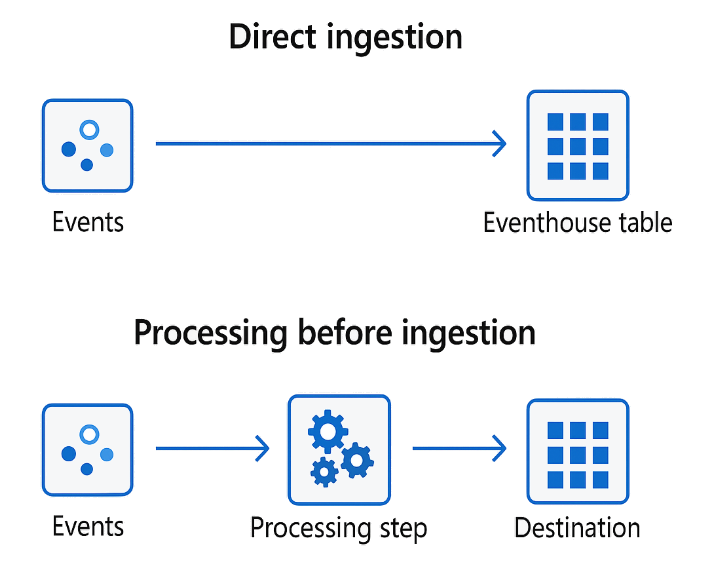
Direct ingestion is the simplest path. Events arrive from a source such as IoT devices, applications, or an event broker, and they are immediately written into the target system without any intermediate shaping. This mode gives the lowest latency because nothing happens in between. It is most useful when you want to preserve raw events for later analysis, replay, or transformations that happen downstream. It is also the right choice when your first priority is freshness and the consumers are able to handle any necessary cleaning or shaping themselves.
However, many real-time workloads require more than just landing raw events. That’s where processing before ingestion becomes relevant. In this mode, events flow through a processing step, often a Stream Processing job, before they land in a table or get forwarded to another service.
Processing
Processing can include filtering out unwanted events, normalising formats, joining with reference data to enrich context, detecting anomalies, or creating aggregated views such as rolling counts or metrics. This does add some latency, because transformations take time to compute, but the trade-off is usually improved data quality and reduced complexity for downstream systems.
Another benefit of processing before ingestion is being able to reduce storage and compute costs. By filtering noisy or duplicate events early, you avoid ingesting unnecessary data. At the same time, curated streams can make life easier for data consumers who expect well-structured, high-quality information.
So, neither mode is better; they serve different purposes. Direct ingestion optimizes for speed and fidelity, while processing before ingestion optimizes for quality and readiness for analytics. In most real-time solutions, you’ll see a combination of both depending on the requirements for each downstream consumer.
Learn more about Fabric RTI
If you really want to learn about RTI right now, we have an online on-demand course that you can enrol in, right now. You’ll find it at Mastering Microsoft Fabric Real-Time Intelligence
2026-03-30