
Fabric RTI 101: Routing Events
Routing is one of the features that makes Eventstreams especially powerful in Fabric. It gives you fine-grained control over where different types of events end up. Instead of building separate ingestion pipelines for every scenario, you can manage multiple flows in one stream and branch the data based on rules you define.
For example, imagine a company that handles both IoT telemetry and financial transactions. IoT data, like sensor readings, is most valuable in a KQL database, where you can run fast time-series analysis and detect anomalies. At the same time, financial transactions are better suited to a warehouse, where structured schemas and BI reporting tools can shine. With routing, both event types can enter the same Eventstream, but the system automatically directs them to the most appropriate destination.
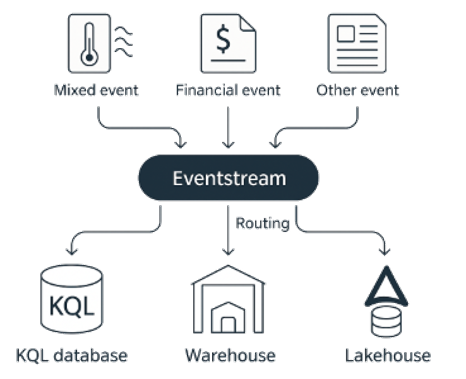
Routing decisions can be based on different aspects of the event — the type of event, the source it came from, or even a specific field value.
For instance, you could route events from certain devices into one lakehouse, while events above a certain transaction amount go into a fraud detection pipeline.
This flexibility means you can support very complex event-driven architectures without needing to duplicate infrastructure.
The result is a much more efficient architecture. Instead of maintaining separate ingestion pipelines for every use case, you can rely on one unified Eventstream that branches events intelligently. That reduces overhead, keeps management simpler, and ensures your downstream systems only receive the data that’s relevant to them.
Routing is about putting the right events in the right place at the right time. It makes your real-time data flows both smarter and more efficient.
Learn more about Fabric RTI
If you really want to learn about RTI right now, we have an online on-demand course that you can enrol in, right now. You’ll find it at Mastering Microsoft Fabric Real-Time Intelligence
2026-03-22