
Fabric RTI 101: CDC vs CES Comparison

This diagram highlights the difference between Change Data Capture (CDC) and Change Event Streams (CES) — two ways of turning databases into real-time event sources.
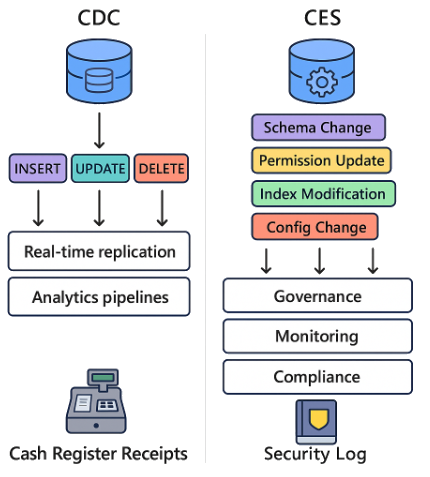
On the left side, we see CDC. Here the focus is on row-level changes. Every time a row is inserted, updated, or deleted in a table, that operation is captured and streamed out as an event. Those events typically feed into real-time replication or analytics pipelines. In other words, CDC makes sure your downstream systems always have fresh copies of your data. It’s like having a live feed of every transaction at the cash register. That’s why we use the analogy here of cash register receipts — you get a record of each sale exactly as it happens.
On the right side, we see CES. This doesn’t track rows of data — it tracks structural and administrative events in the database. Examples include schema changes, permission updates, index modifications, or configuration changes. These are the kinds of things that affect the database environment itself. The output of CES is especially valuable for governance, monitoring, and compliance. It answers questions like: Who changed the schema? Who updated permissions? What structural changes happened in production? That’s why the analogy here is a security log — it records who unlocked the door, who moved the shelves, and who changed the locks, rather than just the sales at the register.
CDC and CES complement each other. CDC tells you how the data itself changes, while CES tells you how the platform and structure around that data evolves. Together, they provide a complete real-time picture of both operational activity and governance.
Comparison Summary
| Feature | CDC (Change Data Capture) | CES (Change Event Streams) |
|---|---|---|
| Focus | Row-level data changes | Structural, metadata, and admin events |
| Captures | Inserts, updates, deletes | Schema changes, permissions, config |
| Use Cases | Real-time replication, analytics | Governance, monitoring, compliance |
| Granularity | Operational data facts | Platform/environment changes |
| Impact | Keeps downstream data fresh | Tracks system security and integrity |
| Analogy | Cash register receipts (sales) | Security log (who opened the store, who moved shelves) |
This comparison makes it clear that CDC and CES are complementary. CDC is all about row-level changes — capturing inserts, updates, and deletes so that downstream systems stay in sync and analytics pipelines always have fresh data. CES, by contrast, looks at the environment itself — schema changes, permission updates, index modifications, configuration changes.
CDC answers the question What happened to the data? while CES also answers What happened to the database itself?. Together, they provide a complete picture. Both perspectives are essential for real-time intelligence and governance.
Learn more about Fabric RTI
If you really want to learn about RTI right now, we have an online on-demand course that you can enrol in, right now. You’ll find it at Mastering Microsoft Fabric Real-Time Intelligence
2026-02-20