
Fabric RTI 101: Event-Driven vs Request-Driven Systems
Most of the systems we’ve worked with historically are request-driven. In this model, a client asks for information and the server provides it. Think about browsing a website: you type in a URL, your browser requests the page, and the server responds with the content. That’s a pull model — the client decides when it wants data. It’s predictable, it’s synchronous, and it’s been the backbone of web applications for decades.
But when we shift into the world of event-driven systems, the model looks very different. Instead of waiting for a client to request data, the system pushes events whenever something happens. For example, a temperature sensor might publish a new reading every second, a motion detector might send an alert when it detects movement, or a financial system might immediately publish an event when a payment is authorized. No one has to ask for this data — it’s emitted automatically, in real time, as the events occur.
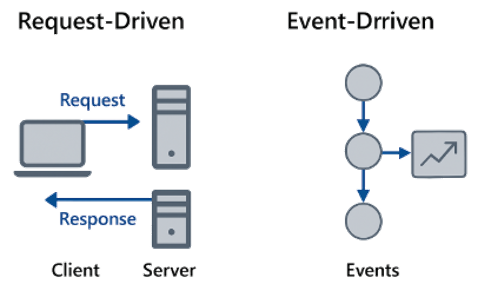
A key feature of event-driven systems is that they’re asynchronous and continuous. Events don’t arrive on a fixed schedule, and they don’t wait for someone to ask for them. They happen when they happen — and they flow continuously into your pipeline. That makes them a perfect fit for use cases where timing really matters.
This model is especially well suited for domains like IoT, where thousands of sensors are continuously reporting telemetry; financial systems, where transactions must be captured and acted upon the moment they’re approved; or operational monitoring, where log events or alerts are generated constantly.
And this is what makes event-driven systems so powerful for real-time intelligence. Because the data comes to us the moment it’s created, we can immediately analyze it, detect anomalies, and even trigger automated actions. In other words, event-driven architecture isn’t just a different way of moving data — it’s what enables real-time pipelines and automation to work effectively.
Request-driven systems are about pulling data when you need it, while event-driven systems are about pushing data as soon as it exists. For real-time intelligence, event-driven is the model that unlocks immediacy and automation.
Analogy: Request-driven is like checking the mailbox every day — you only see what’s inside when you look. Event-driven is like getting text alerts on your phone — the information arrives instantly, without you asking.
Learn more about Fabric RTI
If you really want to learn about RTI right now, we have an online on-demand course that you can enrol in, right now. You’ll find it at Mastering Microsoft Fabric Real-Time Intelligence
2026-01-31