
Fabric RTI 101: What is the Real-Time Hub?
The Real-Time hub is the single, tenant-wide entry point for working with real-time data in Microsoft Fabric. Every Fabric tenant has exactly one Real-Time hub, and it exists independently of individual workspaces.
Single logical place for streaming data
The Real-Time hub is the single, tenant-wide entry point for working with real-time data in Microsoft Fabric. Every Fabric tenant has exactly one Real-Time hub, and it exists independently of individual workspaces.
Real-time data is treated as a shared organizational asset, not something hidden inside isolated projects. Rather than needing to know which workspace or Eventstream a data source lives in, users can start at the Real-Time hub and work outward from there. This design helps reduce duplication and makes it easier for teams to reuse existing streaming data rather than recreating ingestion pipelines.
Unified catalog of streams and tables
The Real-Time hub acts as a catalog for data in motion. It shows available streams produced by Eventstreams, as well as KQL tables that store real-time data in Eventhouses. From a operational perspective, this is useful because it separates discovery from implementation. Users can browse what real-time data exists before they decide how to analyze it.
This is especially helpful in larger tenants, where multiple teams may be producing streams for different purposes. The hub makes those streams visible and understandable without requiring deep knowledge of their underlying configuration.
Connects to many sources
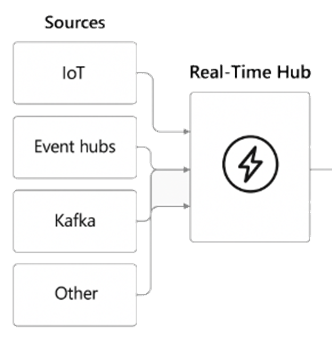
Another role of the Real-Time hub is to provide a consistent entry point for connecting to streaming data sources. From the hub, users can initiate ingestion from sources such as Azure Event Hubs, IoT Hub, Kafka, and change-data-capture feeds.
While the ingestion logic itself is implemented using Eventstreams, the hub provides the starting context — it answers the question, What real-time data do we want to bring into Fabric?
This reduces friction for onboarding new data sources and encourages a more standardized approach to real-time ingestion across teams.
Manage, preview, and act on data
The Real-Time hub is not just a list of assets. It also allows users to preview live data, navigate to the owning Eventstream or Eventhouse, and understand how data is flowing in near real time.
From there, the data can be consumed by KQL queries, visualized in dashboards, or used to trigger actions through tools like Activator.
This makes the hub a practical operational surface, not just a catalog — it supports exploration, validation, and downstream use of real-time data.
Why it matters
Overall, the Real-Time hub simplifies real-time analytics by centralizing visibility and access to streaming data. Instead of thinking first about infrastructure or configuration, users can think first about the data itself.
This supports better collaboration, reduces duplicated effort, and helps organizations treat streaming data as a shared, governed resource. In practice, it becomes the front door to Real-Time Intelligence in Microsoft Fabric.
As with other aspect of Fabric RTI, I expect to see the Real-Time hub evolve over time, to become even more useful.
Learn more about Fabric RTI
If you really want to learn about RTI right now, we have an online on-demand course that you can enrol in, right now. You’ll find it at Mastering Microsoft Fabric Real-Time Intelligence
2026-01-29