
Fabric RTI 101: What are Events?
In real-time intelligence, everything starts with the concept of an event. An event is the most fundamental unit of real-time data — it’s simply a record that something happened.
That something could be almost anything, depending on your business. In finance, an event might be a stock trade or a payment transaction. In a web application, it might be a customer clicking a button, logging in, or abandoning a shopping cart. In IoT, it could be a sensor reading like temperature, vibration, or GPS coordinates. Even a server log entry or an error message can be considered an event.
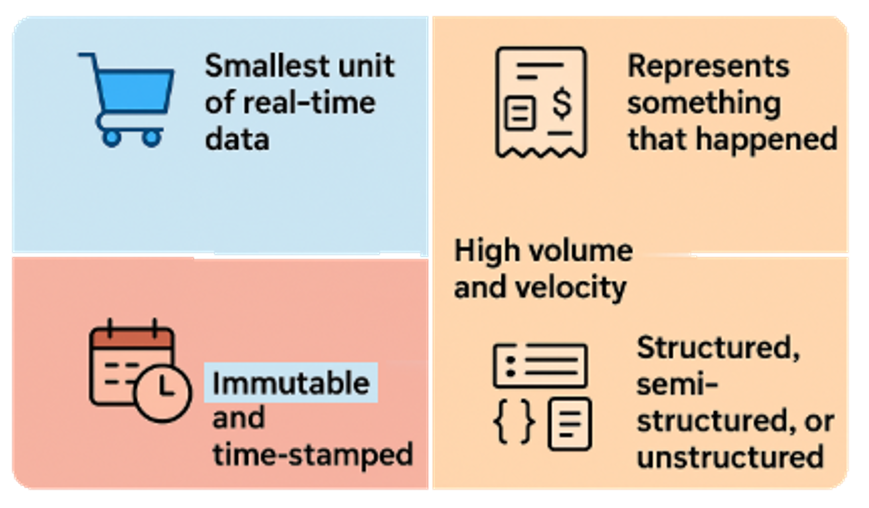
A key property of events is that they are time-stamped. The when is just as important as the what. Real-time analytics is built on the idea of understanding sequences of events — what happened first, what happened next, and how often something happens over time. Without time, you can’t reason about trends, detect anomalies, or correlate related actions.
Another important property is that events are immutable. Once they’re created, they don’t change. Think of them as facts in time. If a correction is needed, that’s a new event — you never go back and edit the old one. This immutability is crucial because it means your event stream is a reliable, unchanging record of what really occurred. It also has a big impact on how efficiently specialist databases can store this type of data.
Events also vary in how they’re represented. Some are structured, like rows in a relational table — for instance, a transaction record with fields like amount, merchant, and timestamp. Others are semi-structured, like JSON payloads coming from an API or an IoT device. And some are unstructured, such as plain-text log entries. Real-time systems need to be able to handle all of these, because you rarely have the luxury of only one format.
And finally, events typically arrive at high volume and high velocity. We’re talking about thousands, millions, or even billions of events flowing in continuously. Think about the number of credit card transactions happening globally in a single second, or the number of sensor readings from a connected car fleet. The sheer speed and scale of events is what makes real-time systems both powerful and challenging.
Think of an event as a lightweight, immutable, time-stamped fact about something that happened. Every real-time intelligence system is built around capturing, processing, and analyzing these events as they occur.
Learn more about Fabric RTI
If you really want to learn about RTI right now, we have an online on-demand course that you can enrol in, right now. You’ll find it at Mastering Microsoft Fabric Real-Time Intelligence
2026-01-19