
Fabric RTI 101: Batch Processing vs Streaming
Batch processing has been the backbone of data analytics for decades. The idea is simple: you collect data over a period of time, maybe hours or a whole day, and then process it in one big chunk. This is how traditional ETL pipelines and overnight data warehouse loads work. It’s efficient when immediacy doesn’t matter — for example, producing a daily sales report each morning.
But the limitation is obvious: if you need to react quickly, batch just doesn’t cut it. By definition, you’re waiting for the batch window to complete before you see the results. If fraud is happening right now, or if a customer is struggling with your app this very minute, a batch report tomorrow morning is far too late.
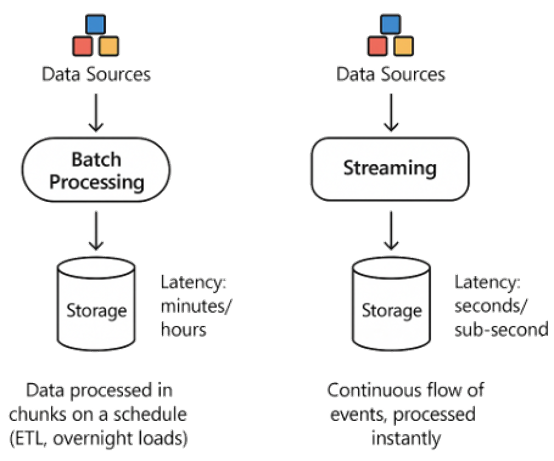
That’s where streaming comes in. With streaming, data is continuously flowing into the system and being processed as it arrives. There’s no waiting period. Events are analyzed as they happen, which gives you the ability to respond within seconds or even milliseconds. This is the model behind real-time fraud detection, IoT telemetry analysis, and live customer interaction monitoring.
Of course, these two models have very different implications for system architecture, storage, and cost. Batch systems are typically simpler, because you’re just processing static chunks of data at set intervals. Streaming systems, on the other hand, need to be always on, resilient to high volumes of data, and capable of keeping up with a continuous firehose of events. That comes with more engineering effort and often higher compute costs.
That’s why, in practice, most modern systems don’t exclusively pick one or the other — they use a hybrid approach. You’ll often hear about the lambda or kappa architectures, which are ways of blending batch and streaming. For example, you might use streaming for immediacy — detecting anomalies or sending alerts in real time — but still rely on batch for historical processing and deeper analysis.
Microsoft Fabric is built with this hybrid world in mind. It gives you the ability to handle both batch and streaming pipelines, and even combine them where appropriate. That way, you can get the best of both worlds: streaming for speed, batch for completeness.
Learn more about Fabric RTI
If you really want to learn about RTI right now, we have an online on-demand course that you can enrol in, right now. You’ll find it at Mastering Microsoft Fabric Real-Time Intelligence
2026-01-15